PCOS Supplements: Inositol, Berberine & What Actually Works
The supplement market for PCOS is overwhelming — and much of it is hype. This guide focuses only on supplements with credible research behind them, ranked by evidence quality, so you can make informed decisions with your healthcare provider.
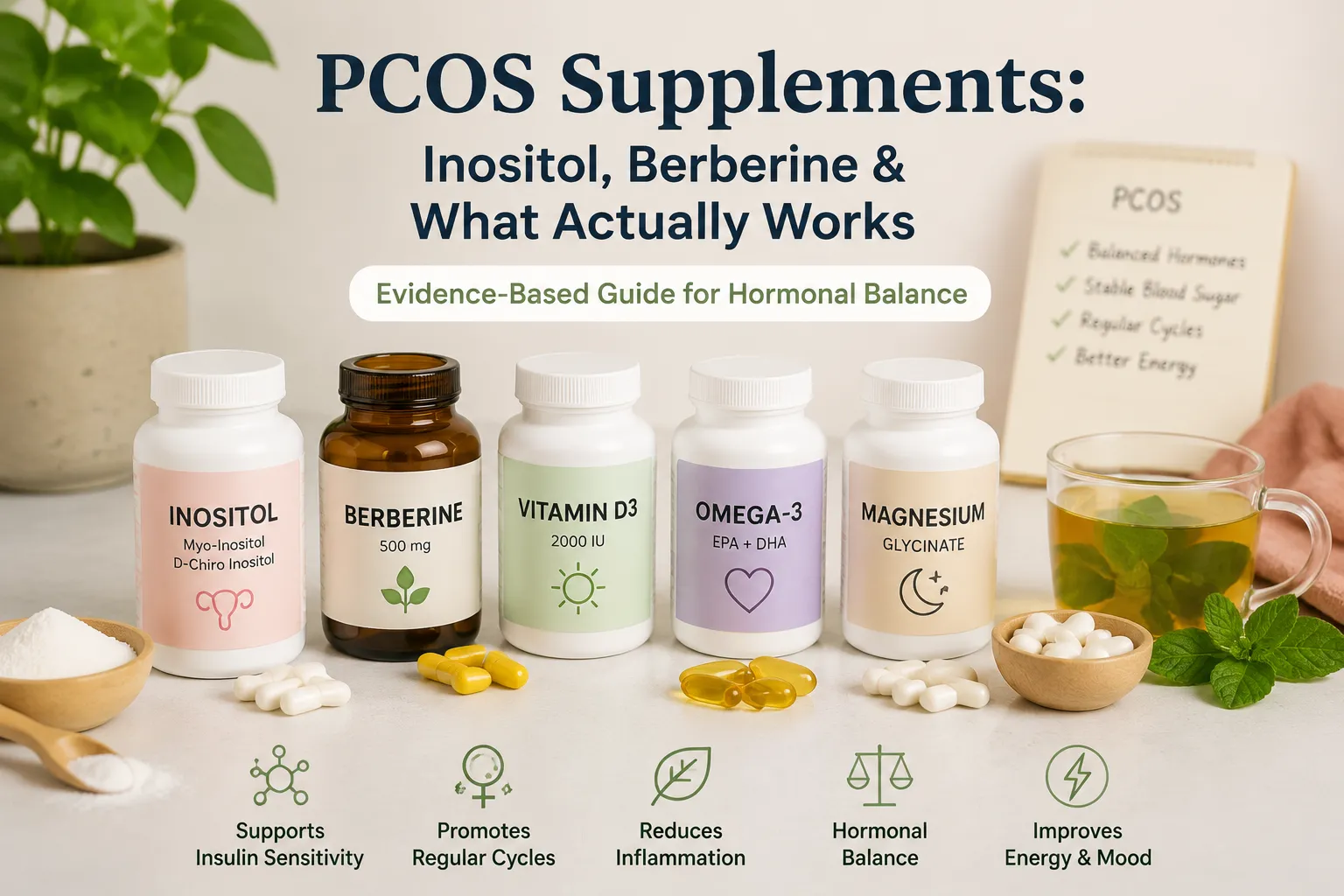
Quick Summary: PCOS Supplements Ranked by Evidence
| Supplement | Evidence | Best For | Typical Dose |
|---|---|---|---|
| Inositol (myo + D-chiro) | Strong | Insulin resistance, cycle regularity, egg quality | 4g myo + 100mg D-chiro daily |
| Berberine | Strong | Insulin resistance, blood sugar, cholesterol | 500mg 2–3x daily with meals |
| Vitamin D | Strong | Insulin sensitivity, mood, cycle regularity | 1,000–4,000 IU daily (test first) |
| Omega-3 (fish oil) | Moderate | Inflammation, triglycerides, mood | 1–3g EPA+DHA daily |
| Magnesium | Moderate | Insulin sensitivity, sleep, anxiety | 200–400mg glycinate at night |
| NAC (N-Acetyl Cysteine) | Moderate | Ovulation, insulin resistance, inflammation | 600mg 2x daily |
| Spearmint tea | Emerging | Anti-androgen (hirsutism) | 2 cups daily |
| Zinc | Emerging | Acne, hair loss, inflammation | 25–50mg daily |
Important: Supplements are not a replacement for lifestyle changes. Diet, exercise, sleep, and stress management remain the foundation of PCOS management.
Inositol: The Most Researched PCOS Supplement
Inositol is a B-vitamin-like compound that plays a key role in insulin signaling. Research from the European Review for Medical and Pharmacological Sciences shows it can significantly improve insulin sensitivity, restore ovulation, and improve egg quality in women with PCOS.
The 40:1 Ratio
Your body uses two forms: myo-inositol and D-chiro-inositol. Research supports a 40:1 ratio (4,000mg myo : 100mg D-chiro) as the most effective combination. This ratio mirrors what your body naturally produces.
What Inositol Does for PCOS
- Improves insulin sensitivity — works at the cellular level to help your body respond to insulin more effectively
- Restores ovulation — studies show improved cycle regularity within 2–3 months
- Improves egg quality — particularly relevant for fertility treatment
- Reduces testosterone — which can improve acne, hirsutism, and hair loss
- May improve mood — inositol is used in higher doses for anxiety (separate from PCOS dosing)
How to Take Inositol
- Split into 2 doses (2g myo morning + 2g myo evening)
- Take with or without food — both are fine
- Powder form mixes easily into water (slightly sweet taste)
- Allow 2–3 months to see full effects on cycle regularity
- Generally very well tolerated — mild GI discomfort in some at high doses
Berberine: The “Natural Metformin”
Berberine is a plant compound found in goldenseal, Oregon grape, and barberry. A meta-analysis published in the Journal of Clinical Endocrinology & Metabolism found berberine comparable to metformin for improving insulin resistance in PCOS — with fewer GI side effects for some women.
What Berberine Does
- Lowers fasting glucose and insulin — activates AMPK, the same pathway as metformin
- Improves cholesterol profile — reduces LDL and triglycerides
- Reduces inflammation — lowers CRP and other inflammatory markers
- May support weight loss — modest effect on visceral fat
How to Take Berberine
- 500mg 2–3 times daily, always with meals (reduces GI side effects)
- Start with 500mg once daily and increase over 1–2 weeks
- Common side effects: diarrhea, cramping, gas (usually temporary)
- Do not combine with metformin without medical supervision — they have similar mechanisms and can cause hypoglycemia together
- May interact with some medications — always check with your doctor
Use our HOMA-IR Calculator to check your insulin resistance before and after starting berberine. Retest after 3 months to track improvement.
Vitamin D: Most Women with PCOS Are Deficient
Research shows that 67–85% of women with PCOS have vitamin D deficiency. According to a study in the Journal of Clinical Endocrinology & Metabolism, low vitamin D is associated with worse insulin resistance, higher androgen levels, and lower fertility in PCOS.
- Get tested first — ask for serum 25(OH)D levels. Optimal is 40–60 ng/mL
- Dose depends on your level — typically 1,000–4,000 IU daily for maintenance; higher for deficiency (under medical supervision)
- Take with fat — vitamin D is fat-soluble; absorption improves with a meal containing fat
- Retest after 3 months to adjust dose
Omega-3 Fatty Acids: For Inflammation & Mood
PCOS involves chronic low-grade inflammation. Omega-3s (EPA and DHA from fish oil) reduce inflammatory markers and may improve:
- Triglyceride levels (often elevated in PCOS)
- Mood and anxiety symptoms
- Insulin sensitivity (modest effect)
- Hormonal balance (small reductions in testosterone)
Dose: 1–3g combined EPA+DHA daily. Choose a high-quality fish oil that's been third-party tested for purity. Algae-based options work for vegetarians.
Magnesium: Sleep, Anxiety & Insulin
Magnesium deficiency is common in PCOS and can worsen insulin resistance, anxiety, sleep problems, and muscle tension. Research suggests supplementation may improve fasting glucose and insulin levels.
- Best form: Magnesium glycinate (best absorbed, doesn't cause diarrhea)
- Dose: 200–400mg at bedtime (supports sleep too)
- Avoid: Magnesium oxide (poorly absorbed, mostly a laxative)
- Safe to combine with other PCOS supplements
NAC (N-Acetyl Cysteine): Underrated for PCOS
NAC is a powerful antioxidant and anti-inflammatory. Multiple studies suggest it can improve ovulation rates, reduce testosterone, and improve insulin resistance in PCOS — possibly with fewer side effects than metformin.
- Dose: 600mg twice daily
- Benefits: Antioxidant, supports liver detoxification, improves ovulation, anti-inflammatory
- Note: Has a strong sulfur smell — capsules are easier than powder
Spearmint Tea: Gentle Anti-Androgen
A small but promising study in Phytotherapy Research found that 2 cups of spearmint tea daily for 30 days reduced free testosterone levels in women with PCOS. It may help with hirsutism (unwanted hair growth) over time.
- Mild effect — takes 1–3 months to notice changes in hair growth
- Safe, no significant side effects
- Use as a complement to other treatments, not a primary therapy
What Doesn't Work (Or Has Weak Evidence)
- Vitex (chasteberry): Popular but evidence is weak for PCOS specifically. May help some PMS symptoms but not a reliable PCOS treatment.
- Evening primrose oil: Insufficient evidence for PCOS. May help breast pain but unlikely to affect hormonal imbalance.
- Apple cider vinegar: Social media hype. No meaningful clinical evidence for PCOS or insulin resistance at the doses typically consumed.
- Ashwagandha: May help stress and cortisol, but limited PCOS-specific research. Not harmful, but don't expect hormonal changes.
- “Hormone balance” blends: Most contain sub-therapeutic doses of multiple ingredients. You're better off taking individual supplements at proper doses.
How to Build a Supplement Stack for PCOS
Don't take everything at once. Start with the foundation and add based on your specific symptoms:
For Everyone with PCOS
- Inositol (40:1 myo:D-chiro) — 4g daily
- Vitamin D — test and supplement to optimal level
- Magnesium glycinate — 200–400mg at night
Add If Insulin Resistant
- Berberine 500mg 2x daily (or metformin from your doctor)
- Omega-3 — 2g EPA+DHA daily
Add If Dealing with Inflammation
- NAC 600mg 2x daily
- Omega-3 (if not already taking)
Add If Hirsutism/Hair Loss
- Spearmint tea 2 cups daily
- Zinc 25–50mg daily
Take our PCOS Type Quiz to identify which type is driving your symptoms and tailor your supplement plan accordingly.
Important Safety Notes
- Tell your doctor about all supplements you take — interactions are possible, especially with metformin, blood thinners, and thyroid medication
- Quality matters — choose brands that are third-party tested (USP, NSF, or ConsumerLab verified)
- Give it time — most supplements need 2–3 months to show measurable effects on hormones and cycles
- Track your progress — monitor cycle length, symptoms, and blood work every 3–6 months
- If pregnant or trying to conceive — check each supplement's safety profile with your OB. Inositol and vitamin D are generally considered safe; berberine should typically be stopped.
Related Articles
Written by
Piaora Editorial Team
Evidence-based guides on pumping, breastfeeding, and PCOS — researched with input from lactation professionals and written for real moms.
Learn more about our team and editorial standards →Frequently Asked Questions
Track Your PCOS Symptoms & Supplement Progress
We're building a PCOS tracker to help you log symptoms, track your cycle, and see how lifestyle changes and supplements affect your body over time. Join the waitlist for early access.
Free. No spam. Privacy Policy