PCOS and Irregular Periods: Causes, Signs & What to Do
Irregular periods are the most common symptom of PCOS — and often the first sign that something is off. But what exactly counts as "irregular"? Why does PCOS disrupt the menstrual cycle? And what can you actually do about it?
This guide answers all of those questions, with evidence-based information and practical steps you can take right now.
What Counts as an Irregular Period?
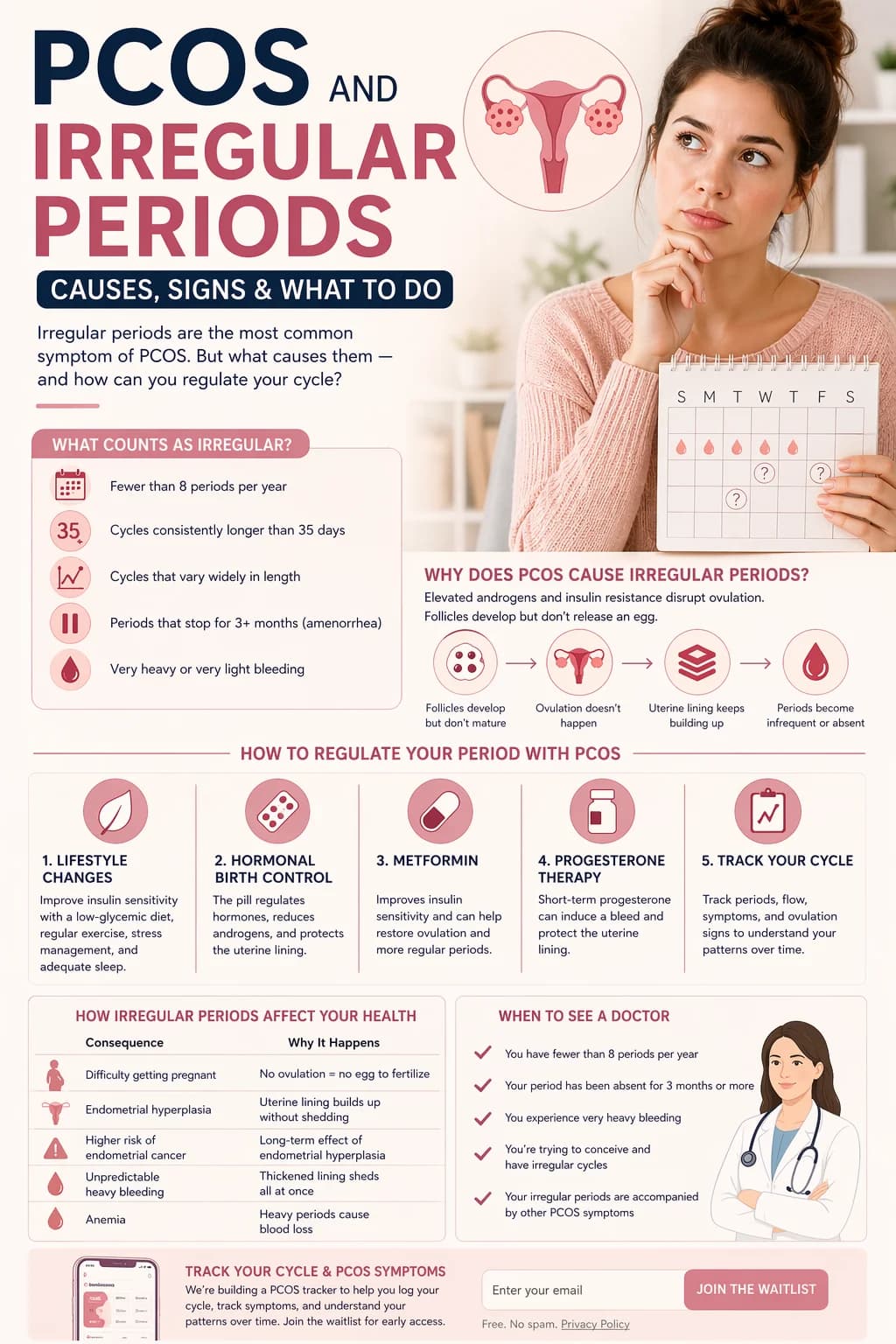
According to the American College of Obstetricians and Gynecologists (ACOG), a normal menstrual cycle is between 21 and 35 days. Anything outside this range — or significant variation from cycle to cycle — is considered irregular.
In the context of PCOS, irregular periods typically look like:
- Fewer than 8 periods per year
- Cycles consistently longer than 35 days
- Cycles that vary widely in length (e.g., 25 days one month, 60 days the next)
- Periods that stop entirely for 3 months or more (amenorrhea)
- Very heavy or very light bleeding when periods do occur
Why Does PCOS Cause Irregular Periods?
The root cause is anovulation — the failure to ovulate regularly. Here's how it happens:
In a normal cycle, the brain signals the ovaries to develop a follicle, which releases an egg (ovulation). After ovulation, progesterone rises, the uterine lining thickens, and if no pregnancy occurs, it sheds as a period.
In PCOS, elevated androgens and insulin resistance disrupt this process. According to the NIH, the follicles begin to develop but don't mature enough to release an egg. Instead, they remain as small cysts on the ovaries. Without ovulation:
- Progesterone doesn't rise
- The uterine lining keeps building up without shedding
- Periods become infrequent, unpredictable, or absent
When a period does eventually occur, it may be heavier than usual because the lining has been building up for longer.
Is It Normal to Have Regular Periods with PCOS?
Yes — some women with PCOS have regular periods. This is more common in women with "lean PCOS" (normal weight) or in cases where the hormonal imbalance is mild. Regular periods don't rule out PCOS, and irregular periods alone don't confirm it.
It's also possible to have regular periods but still not be ovulating — a condition called "silent anovulation." This is why tracking your cycle alone isn't enough; ovulation tracking (through basal body temperature or LH strips) gives a more complete picture.
How Irregular Periods Affect Your Health
Irregular periods aren't just inconvenient — they have real health consequences:
| Consequence | Why It Happens |
|---|---|
| Difficulty getting pregnant | No ovulation = no egg to fertilize |
| Endometrial hyperplasia | Uterine lining builds up without shedding |
| Higher risk of endometrial cancer | Long-term effect of endometrial hyperplasia |
| Unpredictable heavy bleeding | Thickened lining sheds all at once |
| Anemia | Heavy periods cause blood loss |
This is why doctors recommend that women with PCOS have at least 4 periods per year — to protect the uterine lining. If you're having fewer than this, speak to your doctor.
How to Regulate Your Period with PCOS
There is no single solution, but several approaches can help restore more regular cycles:
1. Lifestyle Changes
For women with insulin resistance, improving insulin sensitivity is often the most effective way to restore ovulation and regular periods. According to the Mayo Clinic, even a 5–10% reduction in body weight can restore regular periods in overweight women with PCOS.
- Low-glycemic diet — reduces insulin spikes and lowers androgen levels. See our PCOS diet guide
- Regular exercise — improves insulin sensitivity and supports hormonal balance. Read our PCOS exercise guide
- Stress management — chronic stress elevates cortisol, which disrupts the hormonal axis
- Adequate sleep — poor sleep worsens insulin resistance
2. Hormonal Birth Control
Combined oral contraceptives (the pill) are the most commonly prescribed treatment for regulating periods in PCOS. They work by providing a regular hormonal cycle, reducing androgen levels, and protecting the uterine lining.
The pill doesn't treat the underlying cause of PCOS — periods typically become irregular again when you stop taking it. But it's an effective option for women who aren't trying to conceive.
3. Metformin
Metformin is a diabetes medication that improves insulin sensitivity. In women with PCOS, it can help restore ovulation and more regular periods, particularly in those with significant insulin resistance. It's often used as an alternative to the pill for women who want to preserve fertility. Learn more in our guide to PCOS and insulin resistance. You can also check your levels with our HOMA-IR Calculator.
4. Progesterone Therapy
If you haven't had a period in 3 months or more, your doctor may prescribe a short course of progesterone to induce a withdrawal bleed. This protects the uterine lining and resets the cycle. It doesn't restore regular ovulation on its own but is an important protective measure.
Tracking Your Cycle with PCOS
Tracking your cycle is one of the most useful things you can do — both for understanding your own patterns and for providing your doctor with accurate information.
With PCOS, standard cycle tracking apps can be misleading because they assume a regular 28-day cycle. Try our PCOS Period Predictor for a more realistic estimate. What's more useful is tracking:
- Period start and end dates — to calculate actual cycle length
- Flow heaviness — to identify unusually heavy bleeds
- Symptoms — spotting, cramping, bloating, mood changes
- Ovulation signs — basal body temperature, cervical mucus, LH strips
Over time, this data reveals your personal pattern — which is far more useful than comparing yourself to a "normal" 28-day cycle.
When to See a Doctor
See your doctor if:
- You have fewer than 8 periods per year
- Your period has been absent for 3 months or more
- You experience very heavy bleeding (soaking through a pad or tampon every hour for several hours)
- You're trying to conceive and have irregular cycles
- Your irregular periods are accompanied by other PCOS symptoms
Final Thoughts
Irregular periods are one of the most disruptive aspects of PCOS — but they're also one of the most manageable. Whether through lifestyle changes, medication, or a combination of both, most women with PCOS can achieve more regular cycles with the right approach.
The first step is understanding your own pattern. Track your cycle consistently, bring that data to your doctor, and work together on a plan that fits your goals — whether that's managing symptoms, protecting your long-term health, or trying to conceive.
Related Articles
Written by
Piaora Editorial Team
Evidence-based guides on pumping, breastfeeding, and PCOS — researched with input from lactation professionals and written for real moms.
Learn more about our team and editorial standards →Frequently Asked Questions
Track Your Cycle & PCOS Symptoms
We're building a PCOS tracker to help you log your cycle, track symptoms, and understand your patterns over time. Join the waitlist for early access.
Free. No spam. Privacy Policy