PCOS and Exercise: Best Workouts to Manage Symptoms
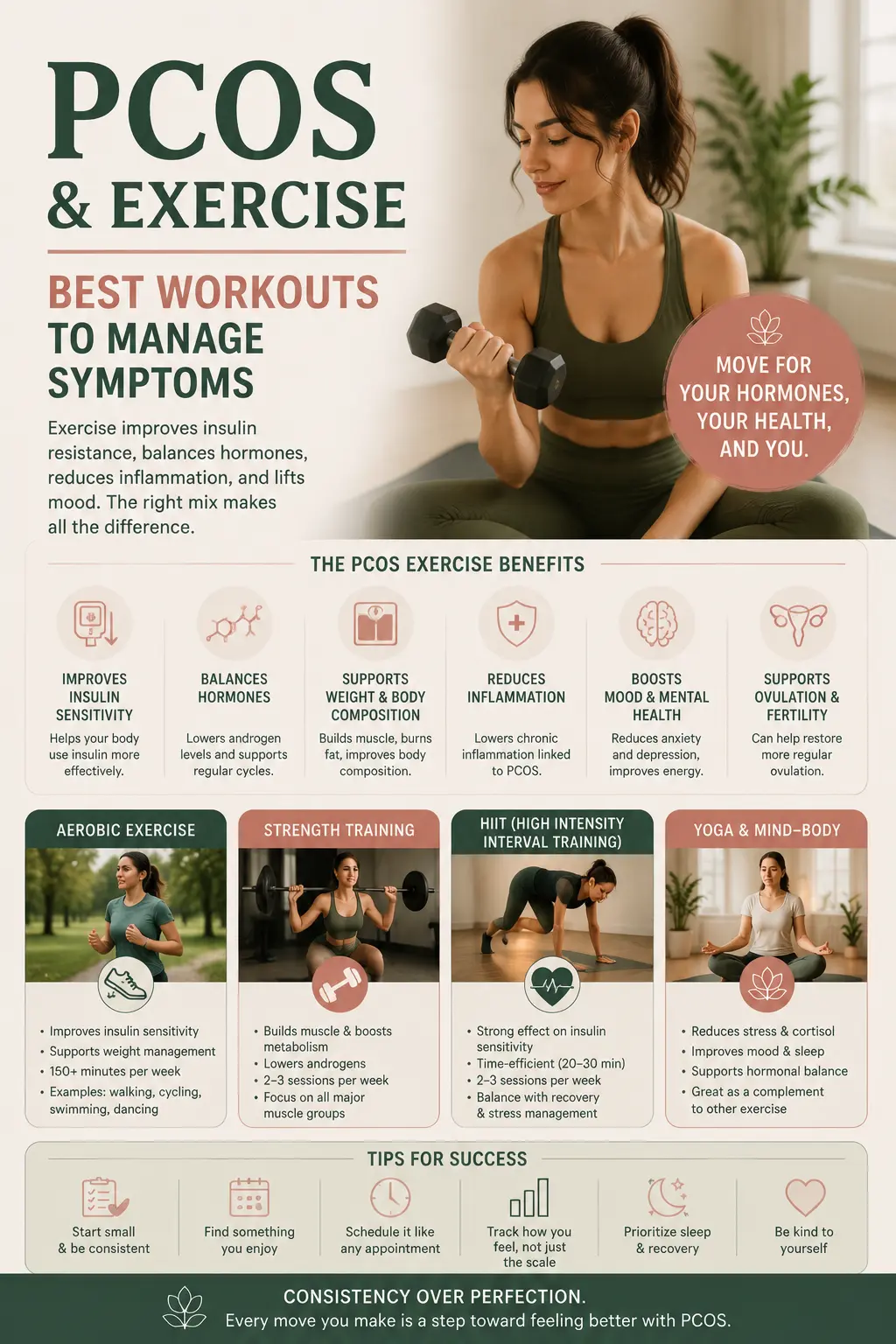
Exercise is one of the most powerful tools for managing PCOS — and one of the most underused. It's not just about weight loss. Exercise directly improves insulin resistance, lowers androgen levels, reduces inflammation, and supports mental health. All of these matter deeply for PCOS.
But what kind of exercise? How much? And what should you avoid? Here's what the research actually says.
Why Exercise Matters So Much for PCOS
A 2023 case-control study published in Nutrients found that physical activity, more than diet alone, was linked to lower insulin resistance in women with PCOS. That's a significant finding.
Exercise works on PCOS through several mechanisms:
- Insulin sensitivity — muscle contractions during exercise cause glucose uptake independently of insulin, and this effect persists for hours afterward
- Androgen levels — regular exercise can lower testosterone and other androgens, reducing symptoms like acne, hirsutism, and hair loss
- Weight management — even modest weight loss (5–10%) significantly improves PCOS symptoms, and exercise supports both loss and maintenance
- Inflammation — PCOS involves chronic low-grade inflammation; regular exercise has well-documented anti-inflammatory effects
- Mental health — exercise is one of the most effective interventions for anxiety and depression, both of which are more common in PCOS PCOS and mental health →
- Ovulation — exercise can help restore more regular ovulation in some women with PCOS
Aerobic Exercise: The Foundation
Aerobic exercise (cardio) is the most studied form of exercise for PCOS, and the evidence is consistently positive. Walking, cycling, swimming, dancing, jogging — any activity that elevates your heart rate and keeps it there.
A systematic review and meta-analysis found that aerobic exercise significantly improves insulin sensitivity, reduces BMI, lowers testosterone, and improves quality of life in women with PCOS.
Recommended: At least 150 minutes of moderate-intensity aerobic exercise per week (30 minutes, 5 days). This is the minimum — more is generally better for PCOS, but any amount is beneficial.
Moderate intensity means you can talk but not sing — slightly breathless but comfortable. A brisk walk counts. You don't need to be running.
Strength Training: Underrated for PCOS
Resistance training (weights, bodyweight exercises, resistance bands) is often overlooked for PCOS, but it's highly valuable.
Muscle tissue is the primary site of glucose uptake. More muscle mass means better insulin sensitivity — even at rest. Strength training also:
- Increases resting metabolic rate
- Improves body composition (even without weight loss)
- Reduces visceral (abdominal) fat, which is particularly metabolically harmful
- Lowers testosterone levels
- Supports bone density (important as PCOS can affect bone health long-term)
Recommended: 2–3 sessions per week, targeting all major muscle groups. Squats, deadlifts, push-ups, rows — compound movements that work multiple muscles at once are most efficient.
HIIT: Effective But Use Wisely
High-intensity interval training (HIIT) — alternating short bursts of intense effort with recovery periods — has become popular for PCOS. The research is promising but nuanced.
A systematic review comparing HIIT versus moderate-intensity steady-state exercise found that both improve metabolic markers in PCOS, with HIIT showing slightly better improvements in insulin sensitivity and body composition in some studies.
The case for HIIT:
- Time-efficient — 20–30 minutes achieves similar or better metabolic benefits than longer moderate sessions
- Strong effect on insulin sensitivity
- Effective for fat loss, particularly visceral fat
The caveats:
- High-intensity exercise raises cortisol. If you're already stressed or sleep-deprived, chronic HIIT may worsen HPA axis dysregulation — which can worsen PCOS
- Not suitable as your primary exercise if you're new to exercise or have joint issues
- More isn't always better — 2–3 HIIT sessions per week is plenty
Recommendation: HIIT is a valuable tool, especially for women who are time-poor. But pair it with recovery, sleep, and stress management — not as a punishing daily habit.
Yoga and Mind-Body Exercise
Yoga for PCOS has a small but growing evidence base. It may improve hormonal profiles, reduce anxiety and depression, and support weight management. Its particular strength is in stress reduction — yoga lowers cortisol and activates the parasympathetic nervous system.
Since chronic stress worsens PCOS through cortisol-driven androgen production, stress-reducing movement has real value beyond calorie burning.
Best for: Women who are highly stressed, have significant anxiety, or find high-intensity exercise exacerbates symptoms. Can be combined with other forms of exercise.
How Much Is Enough?
The 2023 International PCOS Guidelines recommend:
- At least 150 minutes of moderate-intensity aerobic activity per week, OR
- 75 minutes of vigorous activity per week, OR
- An equivalent combination of both
- Plus 2–3 sessions of resistance training per week
If you're currently inactive, start with whatever is sustainable — even 20–30 minutes of walking daily is a meaningful starting point that will produce real improvements in insulin sensitivity.
Can Exercise Make PCOS Worse?
In most cases, no. But a few situations deserve attention:
- Overtraining — excessive exercise without adequate recovery raises cortisol chronically, which can worsen androgen levels and disrupt cycles further
- Underfueling — exercising intensely while severely restricting calories stresses the body and can worsen hormonal disruption. Fuel your exercise appropriately
- Using exercise to punish — "earning" food or punishing overeating with exercise is an unhealthy relationship that PCOS makes particularly fraught. Move to feel better, not to compensate
Practical Tips for Getting Started
- Start small and consistent — 20 minutes 4 days a week beats an hour once a week
- Pick something you don't hate — the best exercise is the one you'll actually do
- Combine types — mix aerobic and strength for the best overall benefit
- Track how you feel — energy, mood, and symptom changes are as important as the scale
- Be patient — hormonal changes from exercise take weeks to months to show up in blood tests or symptom scores
- Protect your sleep — avoid intense exercise within 2–3 hours of bedtime, as it can disrupt sleep quality
Exercise vs. Diet: Which Matters More?
Both matter — but for PCOS specifically, research suggests exercise has a uniquely strong effect on insulin resistance, independent of diet or weight loss. Women who exercise regularly have significantly better insulin sensitivity than sedentary women with PCOS, even at the same body weight.
This means you don't have to lose weight first to benefit. Exercise improves PCOS metabolic markers directly, which then makes other aspects (weight management, hormone levels, fertility) easier to address.
Track your PCOS symptoms and energy levels over time
A dedicated PCOS tracker is coming to Piaora. Join the waitlist for early access.
Related Articles
Written by
Piaora Editorial Team
Evidence-based guides on pumping, breastfeeding, and PCOS — researched with input from lactation professionals and written for real moms.
Learn more about our team and editorial standards →