Spectra vs Medela: Honest Comparison for Pumping Moms
Spectra and Medela are the two most popular breast pump brands worldwide. Both make solid pumps — but they're designed with different priorities. Spectra focuses on comfort and customization, while Medela prioritizes speed and portability. Here's an honest breakdown to help you choose.
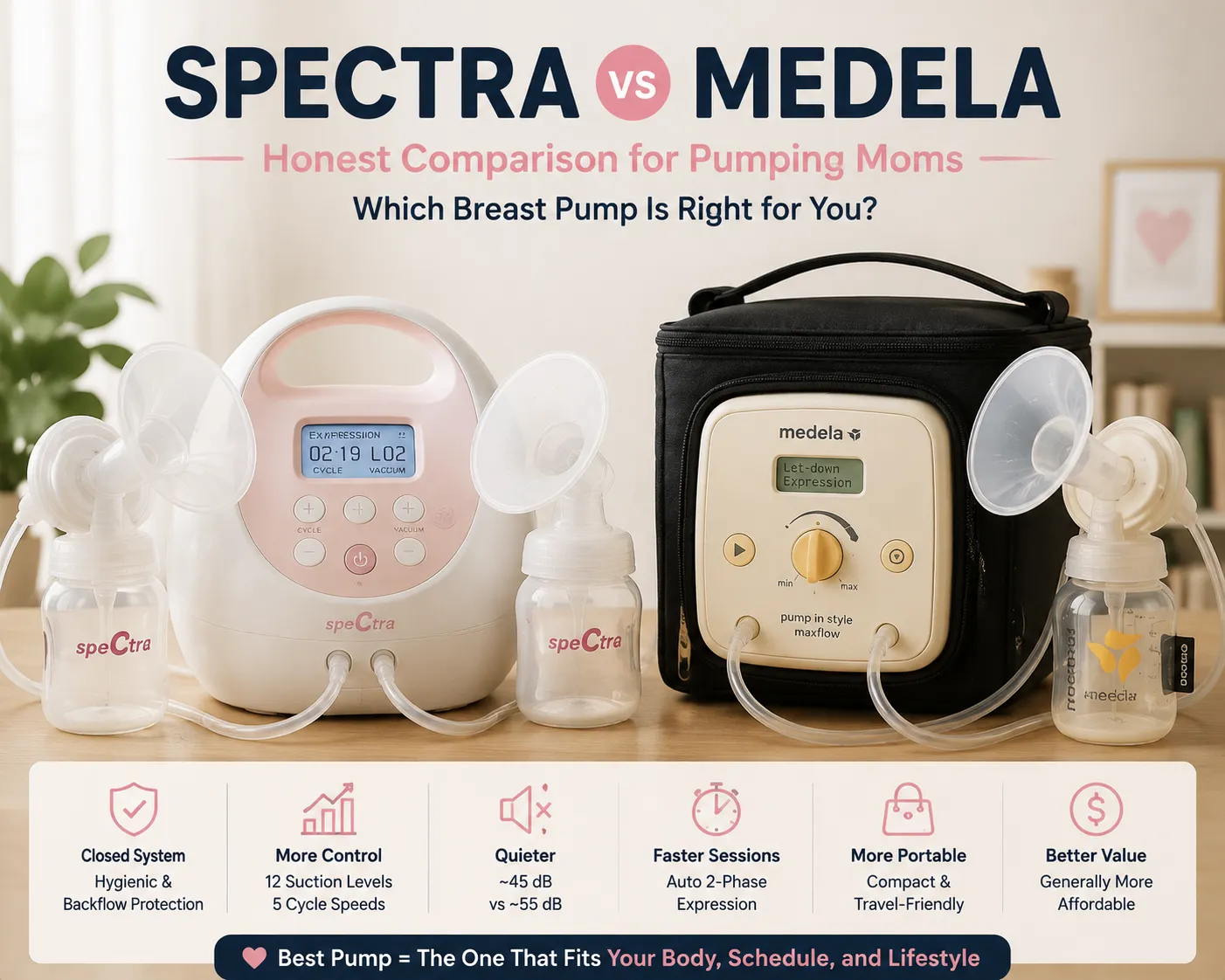
Quick Answer: Which Should You Choose?
| Choose Spectra if… | Choose Medela if… |
|---|---|
| Comfort is your top priority | Speed and efficiency matter most |
| You want fine-tuned control over suction and cycle | You prefer simple, fewer settings |
| You pump mostly at home | You pump at work or on the go |
| You have sensitive nipples or pain issues | You want maximum output in minimum time |
| Budget matters (generally cheaper) | You want wide accessory and parts availability |
Neither brand is objectively “better” — the best pump is the one that fits your body, schedule, and lifestyle. For a broader overview of pump types: how to choose a breast pump.
Full Comparison: Spectra vs Medela
| Feature | Spectra (S1/S2) | Medela (Pump in Style) |
|---|---|---|
| Suction type | Closed system (hygienic, no backflow) | Open system (older models) / Closed (newer MaxFlow) |
| Suction strength | Up to 300 mmHg (12 levels) | Up to 270 mmHg (fewer levels) |
| Cycle speed control | Adjustable (5 levels) | Fixed (auto-switches from stimulation to expression) |
| Noise level | Very quiet (~45 dB) | Moderate (~55 dB) |
| Battery | Built-in rechargeable (S1 only) | Built-in rechargeable (Pump in Style with MaxFlow) |
| Portability | Bulky — better for stationary use | Compact bag design, travel-friendly |
| Flange sizes included | 24mm + 28mm | 24mm + 27mm |
| Parts compatibility | Wide third-party support; fits many flanges | Medela-specific parts; widely available in stores |
| Price range | $80–$180 | $150–$300 |
| Insurance coverage | Covered by most plans | Covered by most plans |
Suction & Comfort: Spectra Wins
Spectra's biggest advantage is control. You can independently adjust both suction strength (12 levels) and cycle speed (5 levels), which means you can fine-tune the pump to match exactly what your body responds to. This is especially important if you have:
- Sensitive nipples or pain during pumping
- Difficulty with let-down (you can stay in stimulation mode longer)
- Variable output at different times of day
Medela's Pump in Style uses a fixed 2-phase pattern: fast stimulation → slower expression. You can adjust suction strength, but the cycle speed switches automatically. Some moms find this simpler; others feel limited.
The comfort difference is real. Many moms who switch from Medela to Spectra report less nipple pain and better let-down. If comfort has been an issue, Spectra is worth trying. For proper flange fit (which matters more than the pump itself): how to find the right flange size.
Speed & Efficiency: Medela Wins
Medela has decades of research behind its suction patterns. The 2-phase expression technology was developed based on studies of how babies actually nurse. For many moms, this results in:
- Faster let-down (auto-switching saves time)
- Shorter overall session time
- Consistent output session to session
If your priority is “get the most milk in the shortest time” — particularly important for pumping at work with limited break time — Medela often delivers.
Noise Level: Spectra Wins Significantly
Spectra pumps are noticeably quieter than Medela. At ~45 dB (Spectra S1) vs ~55 dB (Medela Pump in Style), that's the difference between a quiet library and a normal conversation.
This matters if you:
- Pump at night while partner or baby sleeps
- Take conference calls while pumping
- Share a workspace and want discretion
If noise is a dealbreaker, Spectra is the clear choice. Alternatively, consider a wearable pump as a secondary pump for noise-sensitive situations.
Portability: Medela Wins
Medela's Pump in Style was designed for working moms. It comes in a stylish tote bag, has a compact motor, and the newer MaxFlow version includes a built-in rechargeable battery. The overall footprint is smaller and more travel-friendly.
Spectra's S1 has a built-in battery too, but the unit is larger and rounder — it doesn't fit as neatly into a work bag. The S2 (no battery) is corded only, which limits portability further.
For moms who pump on the go or travel frequently: pumping while traveling for work.
Hygiene: Spectra Wins (Closed System)
Spectra uses a closed system — a barrier (backflow protector) prevents milk from entering the tubing or motor. This means:
- No mold risk in tubing
- Tubes never need to be replaced or dried
- Pump can safely be shared between users (with personal accessory sets)
Older Medela pumps (original Pump in Style) used an open system where milk could potentially enter the tubing. The newer MaxFlow version is closed. If you're buying new, both are now closed-system — but if buying used or secondhand, Spectra is inherently safer.
Parts & Accessories
Medela has the advantage of widespread retail availability. You can find replacement parts at Target, Walmart, and most pharmacies. This is helpful in a pinch.
Spectra has excellent third-party compatibility. Aftermarket flanges (like Maymom, BeauGen cushions) fit Spectra pumps, and the duckbill valve design is widely available online. You'll likely buy parts from Amazon rather than in-store.
Both brands need regular part replacement (every 2–3 months for valves and membranes) to maintain suction. This is normal for all pumps.
Insurance Coverage
Under the Affordable Care Act, most insurance plans cover a breast pump at no cost. Both Spectra and Medela are widely covered — but specific models vary by plan.
- Spectra S1/S2: Covered by most insurers; the S2 is more commonly the “free” option
- Medela Pump in Style: Covered by many plans, sometimes with an upgrade fee for the MaxFlow version
Check with your insurance or a DME supplier (like Aeroflow or Acelleron) to see which models are covered at $0 for your plan. For a complete walkthrough: how to get a breast pump through insurance.
Popular Models at a Glance
| Model | Type | Battery | Best For |
|---|---|---|---|
| Spectra S1 | Double electric | Yes (rechargeable) | Home + occasional portable use |
| Spectra S2 | Double electric | No (corded only) | Home use only; most affordable |
| Spectra S9 | Portable double | Yes | Travel/work secondary pump |
| Medela Pump in Style (MaxFlow) | Double electric | Yes (rechargeable) | Working moms; daily commute |
| Medela Freestyle Flex | Portable double | Yes | Maximum portability; smallest Medela |
| Medela Symphony | Hospital-grade (rental) | No | Low supply; NICU; multiple users |
Can You Switch Pumps Mid-Journey?
Absolutely. Many moms start with one pump and switch or add a second. Common scenarios:
- Start with insurance-provided Spectra S2 → add a portable Medela or wearable pump for work
- Start with Medela at work → switch to Spectra at home for comfort
- Use hospital-grade rental early on → transition to personal pump once supply is established
Your body adapts to different pumps. It may take 2–3 sessions to adjust to a new pump's suction pattern, but output typically normalizes quickly.
Our Recommendation
For most moms: Start with the Spectra S1 (or S2 if budget is tight). The comfort advantage, quiet operation, and closed system make it the better daily driver. Use your insurance to get it at no cost.
If you pump primarily at work with short break windows: the Medela Pump in Style MaxFlow is purpose-built for speed and portability.
Best combination: Spectra S1 at home + wearable pump (Elvie, Willow, or Momcozy) for work/travel. This gives you comfort at home and complete freedom at work.
Whatever you choose, proper flange fit matters more than brand. The most expensive pump with the wrong flange size will give worse results than a basic pump with a perfect fit.
Summary
- Spectra: More comfortable, quieter, more customizable, closed system, cheaper
- Medela: Faster, more portable, simpler controls, parts available in stores
- Both are covered by most insurance plans
- Flange fit matters more than brand — get sized properly regardless of which pump you choose
- Many moms use both — one for home, one for work
Track your output across different pumps and find what works best for your body.
Learn more about Pumping Tracker →Related Articles

Written by
Piaora Editorial Team
Evidence-based guides on pumping, breastfeeding, and PCOS — researched with input from lactation professionals and written for real moms.
Learn more about our team and editorial standards →