NICU Pumping Schedule: How to Build and Maintain Your Supply
When your baby is in the NICU, pumping is your lifeline to them. It's the one thing you can control when everything else feels out of your hands. But pumping without a baby at the breast is harder — your body needs more stimulation, more consistency, and more patience.
This guide gives you a clear, week-by-week pumping schedule designed specifically for NICU moms — along with realistic adjustments for when life gets in the way.
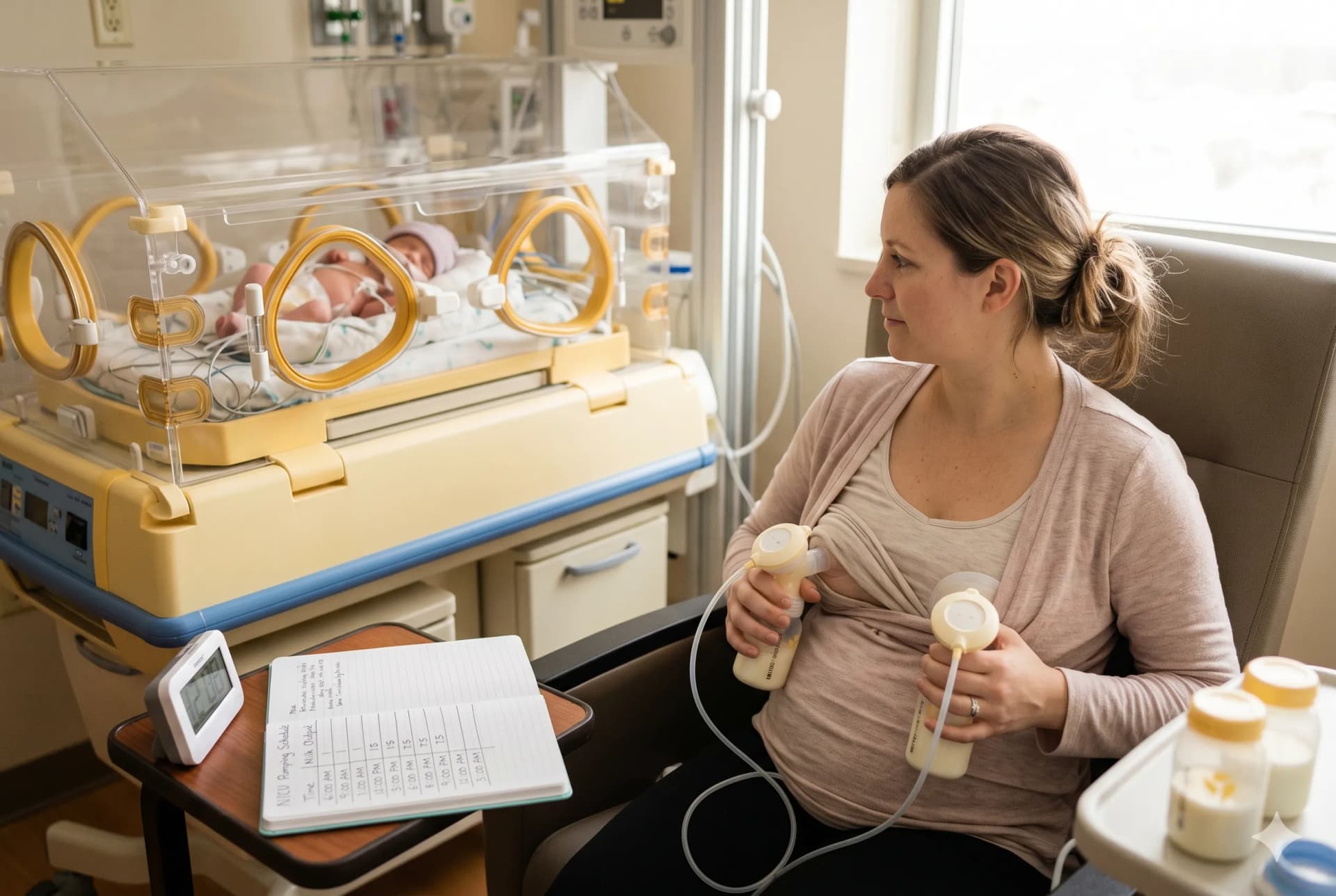
The Golden Rule: Frequency Over Duration
For NICU moms, the most important factor in building supply is how often you pump, not how long each session lasts. According to the La Leche League International, your body responds to frequency of demand. Pumping 8 times for 15 minutes is better than pumping 4 times for 30 minutes.
The goal in the first two weeks is to pump at least 8 times in 24 hours, with no gap longer than 5 hours (including overnight).
Week-by-Week NICU Pumping Schedule
Week 1: Establishment Phase
Goal: 8–12 sessions per day
| Time | Session | Notes |
|---|---|---|
| 6:00 AM | Session 1 | First morning session — prolactin is high |
| 8:30 AM | Session 2 | |
| 11:00 AM | Session 3 | |
| 1:30 PM | Session 4 | Pump at the NICU if possible |
| 4:00 PM | Session 5 | |
| 6:30 PM | Session 6 | |
| 9:00 PM | Session 7 | |
| 12:00 AM | Session 8 | Critical night session |
| 3:00 AM | Session 9 (if possible) | Peak prolactin window |
- Duration: 15–20 minutes per session (or 2 minutes after last drop)
- Use hand expression before and after pumping to maximize output
- Don't skip the midnight–5 AM window — prolactin peaks during these hours
- Output will be small (colostrum) — this is normal and expected
Weeks 2–4: Building Phase
Goal: 8–10 sessions per day, target 500+ ml/day by end of week 4
- Milk has transitioned from colostrum to mature milk
- Volume should be increasing gradually
- Can extend some daytime gaps to 3 hours if supply is stable
- Keep at least one session between midnight and 5 AM
- Consider one daily power pumping session if supply is lagging
How to power pump to boost supply →
Weeks 5–8: Maintenance Phase
Goal: 7–8 sessions per day, maintain 750+ ml/day
- Supply should be well established
- Can potentially space sessions to every 3–3.5 hours during the day
- One overnight session is still important for most moms
- Watch for supply dips — stress, illness, and sleep deprivation can reduce output
- Your baby may begin attempting direct feeds during this period
Weeks 9+: Transition Phase
Goal: Adjust based on baby's direct feeding progress
- As baby starts breastfeeding directly, you can gradually reduce pump sessions
- Replace pump sessions with direct feeds one at a time
- Continue pumping after direct feeds until baby is transferring enough
- Don't drop sessions too quickly — supply drops faster than it builds
Night Pumping: Why It Matters for NICU Moms
Night pumping is one of the hardest parts — but it's also one of the most impactful for NICU moms:
- Prolactin peaks between 1–5 AM — this hormone drives milk production
- Skipping night sessions signals your body to produce less — especially in early weeks
- One overnight session is the minimum — two is ideal in the first month
Tips for surviving night pumps:
- Set up a pumping station next to your bed with everything ready
- Use a hands-free bra so you can relax or doze
- Keep the lights dim — bright lights make it harder to fall back asleep
- Consider a wearable pump for overnight sessions once supply is established
What to Do When You Miss a Session
Life happens. You'll miss sessions — because of exhaustion, travel to and from the NICU, or simply needing a break. Here's what to do:
- Don't double pump to "make up" for missed sessions — your body doesn't work that way
- Just resume your schedule — pump at the next scheduled time
- If you missed multiple sessions, add an extra session or two in the next 24 hours
- One missed session won't crash your supply — patterns of missed sessions will
Signs Your Supply Is On Track
- By day 4–5: Milk has transitioned from colostrum (golden) to transitional/mature milk (white)
- By day 10: Producing at least 200–300 ml per day
- By week 3–4: Producing 500–750 ml per day
- By week 6: Producing 750–1000 ml per day (full supply)
If you're below these benchmarks, don't panic — talk to a lactation consultant. There are strategies to catch up.
When Supply Is Low: What to Try
- Increase pump frequency (add 1–2 sessions per day)
- Add a daily power pumping session
- Pump during or immediately after kangaroo care
- Ensure flange size is correct — wrong size reduces output
- Stay hydrated and eat enough calories
- Ask about galactagogues (only with medical guidance)
7 proven ways to increase milk supply →
Pumping at the NICU vs. at Home
Many NICU moms pump both at the hospital and at home. Each has advantages:
- At the NICU: Being near your baby boosts oxytocin. Pump during or after kangaroo care for best results. Use the hospital-grade pumps available in the unit.
- At home: More comfortable and private. Set up a dedicated pumping station with everything you need within arm's reach.
Aim to pump at least 1–2 sessions at the NICU when you visit, and handle the rest at home.
How to safely store and transport NICU breast milk →
If you're exclusively pumping for a longer period, see our complete guide to exclusively pumping.
Final Thoughts
A pumping schedule for NICU moms is more demanding than a typical pumping routine — because you're building and maintaining supply without a baby at the breast. It's exhausting. It's relentless. And it's one of the most selfless things you can do for your baby.
Track your sessions. Watch your numbers. And know that every single pumping session is making a difference for your baby — even when it doesn't feel like it.
Related Articles



Written by
Piaora Editorial Team
Evidence-based guides on pumping, breastfeeding, and PCOS — researched with input from lactation professionals and written for real moms.
Learn more about our team and editorial standards →