NICU Breast Milk Storage and Transport: Complete Safety Guide
Storing and transporting breast milk for a NICU baby is different from standard breast milk storage. The rules are stricter, the labeling requirements are precise, and mistakes can mean your carefully pumped milk gets discarded. This guide covers everything you need to know to get your milk safely from pump to baby.
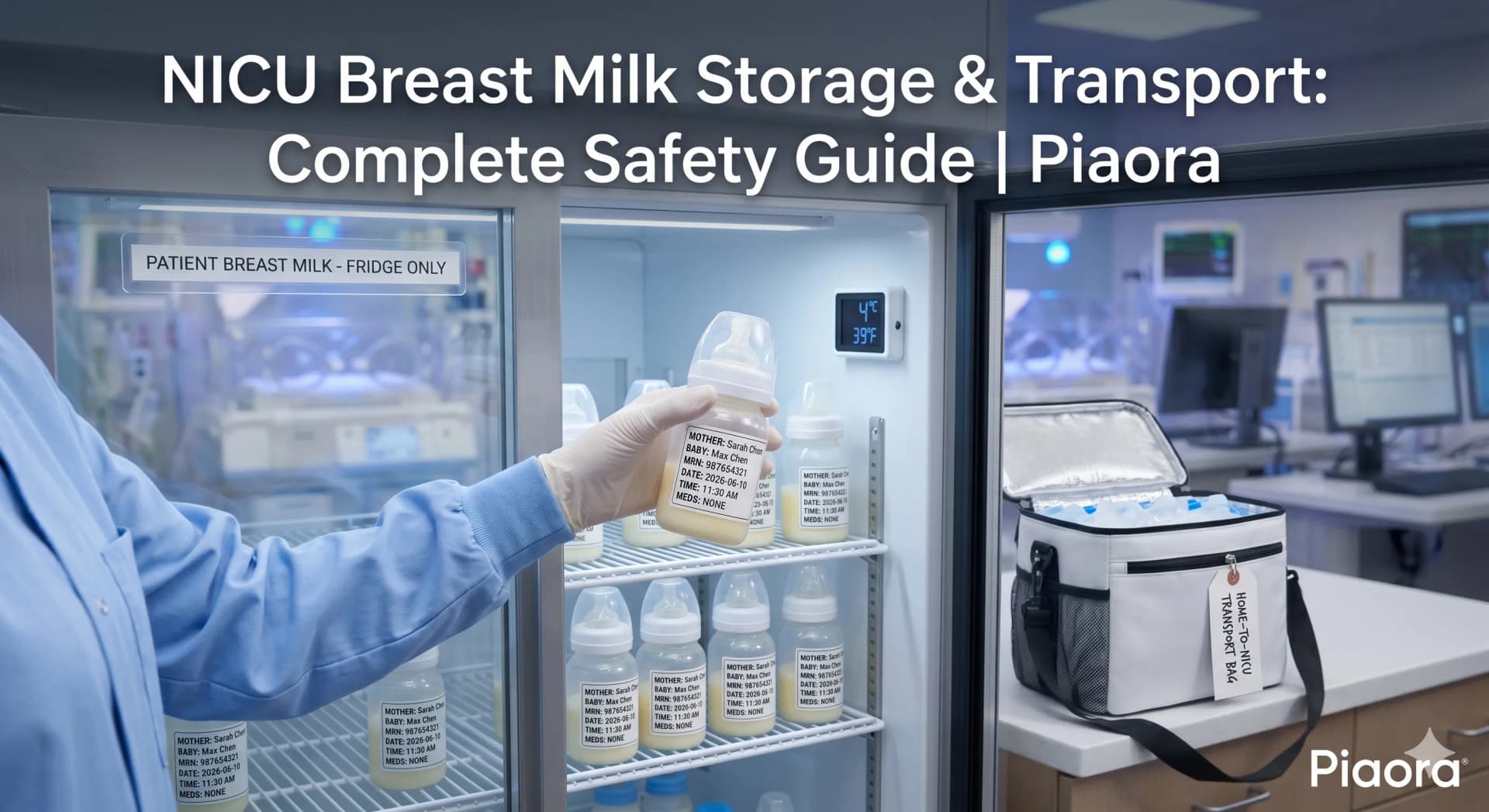
Why NICU Milk Storage Is Different
Premature and critically ill babies have immature immune systems. According to the CDC, bacteria that a healthy full-term baby could handle may cause serious infection in a preemie. Because of this, NICUs have significantly stricter storage and handling protocols than what you'd follow at home.
- Shorter storage time limits than standard guidelines
- Specific approved containers (not standard storage bags)
- Detailed labeling requirements
- Chain-of-custody protocols to prevent mix-ups
- Temperature monitoring during transport
Approved Containers for NICU Breast Milk
Most NICUs do not accept standard breast milk storage bags. Instead, they require:
- Sterile, hard-sided containers — usually provided by the NICU
- BPA-free polypropylene bottles with secure lids
- Sterile syringes for colostrum collection
- NICU-specific collection kits that match the hospital's feeding system
Ask your NICU on day one what containers they accept. Many will provide them for free. Do not assume your home storage bags are acceptable — they often aren't.
Labeling Requirements
Proper labeling is critical in the NICU. Mislabeled milk may be discarded or, worse, given to the wrong baby. Every container must include:
- Mother's full name
- Baby's full name (if different from mother's)
- Baby's medical record number (MRN)
- Date and time of expression
- Any medications or supplements taken (if required by your NICU)
Many NICUs provide pre-printed labels. If yours doesn't, use a permanent marker and write clearly. Label before you start pumping — not after — to reduce the chance of forgetting.
Storage Time Limits for NICU Milk
| Location | NICU Guidelines | Standard Guidelines |
|---|---|---|
| Room temperature | 1–2 hours max | Up to 4 hours |
| Refrigerator (4°C / 39°F) | 48 hours | Up to 4 days |
| Freezer (-20°C / -4°F) | 3 months | 6–12 months |
| Thawed (in fridge) | 24 hours | 24 hours |
Important: These are general NICU guidelines. Your specific hospital may have even stricter rules. Always follow your NICU's protocols — they take priority over any external guidelines.
Transporting Milk to the NICU
Getting milk safely from home to the NICU requires maintaining the cold chain:
- Use an insulated cooler bag with ice packs or frozen gel packs
- Fresh milk should be chilled before transport — place in the fridge for at least 30 minutes before putting in the cooler
- Frozen milk should remain frozen — use enough ice packs to maintain temperature during your commute
- Transport time should be under 1 hour for fresh milk — if longer, freeze it first
- Never leave milk in a hot car — even briefly
What Happens When Milk Arrives at the NICU
When you deliver milk to the NICU, the staff will:
- Verify labeling matches your baby's records
- Check the condition and temperature of the milk
- Log it into their tracking system
- Store it in a designated area (fridge or freezer) with your baby's name
- Follow first-in, first-out rotation for feeding
Milk that doesn't meet their protocols (wrong container, missing label, unclear date, warm on arrival) will be discarded. It's heartbreaking but necessary for your baby's safety.
Pumping and Storing at the NICU
When you pump at the hospital:
- Use the NICU's pump and their sterile collection kits
- Label immediately after pumping
- Give directly to your baby's nurse or place in the designated fridge
- Inform the nurse if it's colostrum (may be prioritized for oral care)
- Keep your pump parts clean according to hospital protocols (often stricter than home cleaning)
Hygiene Protocols for NICU Milk
Cleanliness is especially critical for NICU breast milk:
- Wash hands thoroughly before every pumping session — 20 seconds with soap
- Sterilize pump parts daily (or per your NICU's recommendation)
- Use a dedicated cleaning area — not the kitchen sink where dishes are washed
- Don't use the "fridge hack" (storing pump parts in the fridge between sessions) — this is not safe for NICU milk
- Replace pump parts regularly — worn valves and membranes harbor bacteria
Combining Milk from Different Sessions
Rules for combining pumped milk for NICU babies:
- Only combine milk from the same day
- Cool fresh milk first before adding to previously refrigerated milk
- Never add warm milk to frozen milk
- Label with the earliest date/time of the combined sessions
- Ask your NICU — some do not allow combining at all
What About Donor Milk?
If your own supply isn't meeting your baby's needs, your NICU may offer pasteurized donor breast milk. This is:
- Screened and pasteurized for safety
- Still better than formula for preemies (for NEC prevention)
- A bridge — not a replacement for establishing your own supply
- Often covered by insurance or provided free by the hospital
Don't feel guilty about needing donor milk. Your baby is getting what they need while your supply builds.
NICU pumping schedule to build your supply →
Common Mistakes to Avoid
- Using standard storage bags instead of NICU-approved containers
- Forgetting to label (or labeling after you've already stored multiple containers)
- Transporting milk without adequate cooling
- Storing pump parts in the fridge between sessions
- Combining milk from different days
- Not asking your specific NICU for their protocols (they vary significantly)
For general breast milk storage guidelines (after NICU discharge), see our complete breast milk storage guide.
Use our Milk Storage Calculator to check if stored milk is still safe to use.
Final Thoughts
The protocols can feel overwhelming — especially when you're already exhausted from pumping 8+ times a day. But each rule exists to protect your vulnerable baby. Once you develop a routine, it becomes second nature.
Ask the NICU team for a written copy of their milk handling protocol. Tape it to your pumping station at home. And track every session so nothing falls through the cracks.
Related Articles

Written by
Piaora Editorial Team
Evidence-based guides on pumping, breastfeeding, and PCOS — researched with input from lactation professionals and written for real moms.
Learn more about our team and editorial standards →