How Long Does Breast Milk Last? (Room Temp, Fridge & Freezer)
You just pumped and you're not sure if you can leave it on the counter while you finish a meeting. Or you found a bag in the back of the freezer with no date on it. Or you thawed milk last night and your baby didn't finish it — can you save it?
These are the questions every pumping mom runs into. Here's the complete, CDC-based answer on how long pumped breast milk lasts — and what to do in every situation.
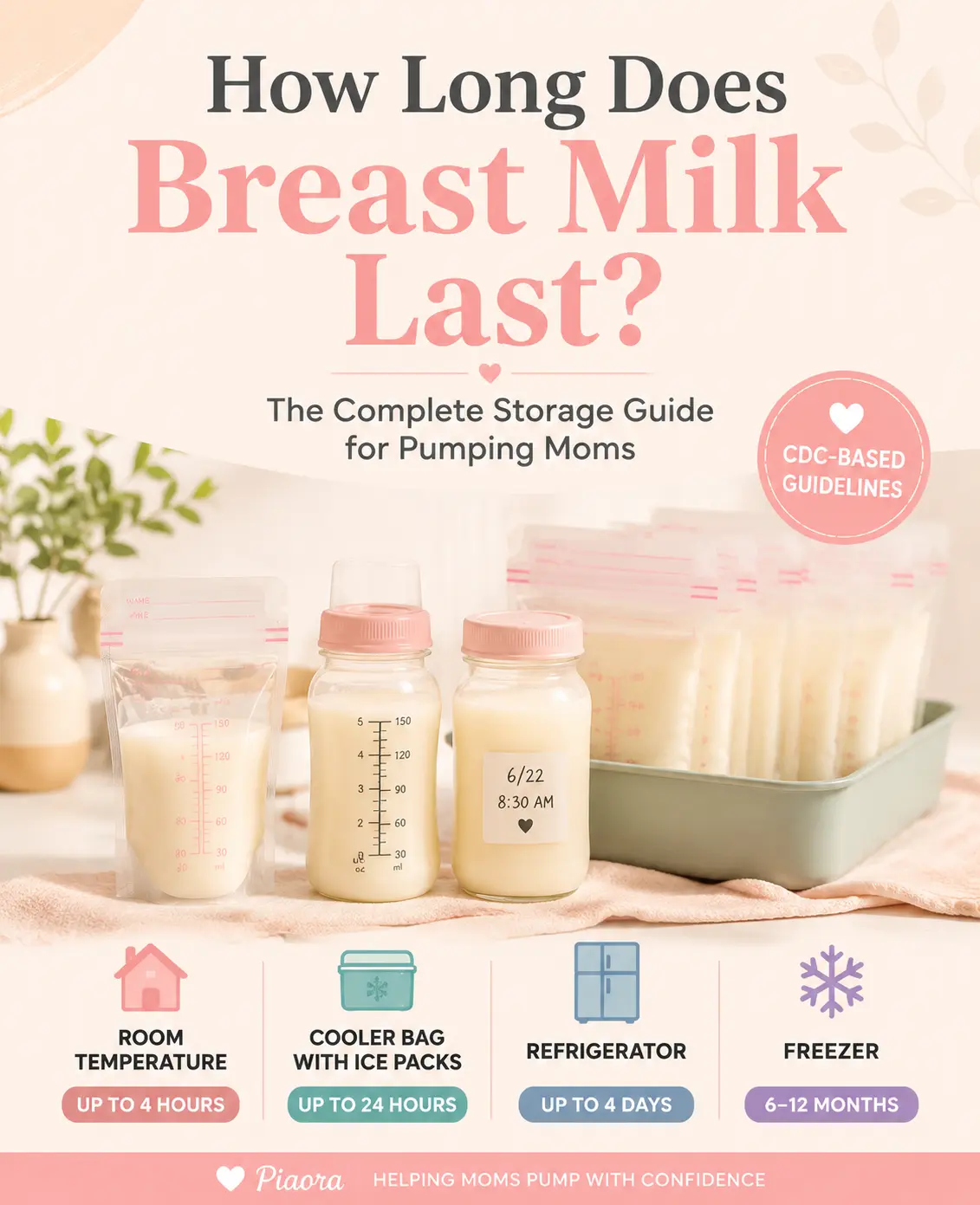
Breast Milk Storage Times at a Glance
According to the CDC's breast milk storage guidelines, here are the safe storage times for freshly expressed or pumped breast milk:
| Location | Temperature | How Long |
|---|---|---|
| Room temperature | Up to 77°F (25°C) | Up to 4 hours |
| Insulated cooler bag with ice packs | ~59°F (15°C) | Up to 24 hours |
| Refrigerator | 40°F (4°C) or colder | Up to 4 days |
| Freezer (standard) | 0°F (-18°C) or colder | 6 months best; up to 12 months |
These guidelines apply to healthy, full-term babies. For premature or medically fragile babies, follow your NICU or pediatrician's specific guidance — the rules may be stricter.
Want to check when your stored milk expires? Use our free Breast Milk Storage Calculator →
How Long Can Breast Milk Sit Out at Room Temperature?
Freshly pumped breast milk can sit out at room temperature — up to 77°F (25°C) — for up to 4 hours. If your room is warmer than that, use it sooner or refrigerate it right away.
The 4-hour clock starts the moment you finish pumping, not when you take it out of the fridge. If you pumped at 9am and it's now 1pm, it's time to refrigerate or discard.
Breast milk has natural antimicrobial properties — lactoferrin, lysozymes, and immunoglobulins — that slow bacterial growth. But they don't eliminate it. Don't push the limits, especially in summer or in a warm office.
Pumping at work? A cooler bag with ice packs extends your window to 24 hours — enough to get through a full workday and bring milk home safely. How often to pump at work →
How Long Does Pumped Breast Milk Last in the Fridge?
Refrigerated pumped breast milk lasts up to 4 days at 40°F (4°C) or colder. Store it at the back of the fridge — not in the door — where the temperature is most stable and consistent.
Some older guidelines said up to 8 days, but the CDC's current recommendation is 4 days for best quality and safety. When in doubt, use the more conservative guideline.
- Always label with the date and time pumped
- Use the oldest refrigerated milk first (first in, first out)
- Don't store in the fridge door — temperature fluctuates every time it opens
- Keep away from raw meat or strong-smelling foods
How Long Does Breast Milk Last in the Freezer?
Frozen breast milk lasts 6 months at best quality, and up to 12 months is acceptable according to the CDC. After 12 months, the milk is likely still safe but nutritional quality and antibody levels decline.
A standard home freezer (attached to a fridge) maintains 0°F (-18°C) and is fine for up to 6 months. A deep freezer or chest freezer can extend this to 12 months.
- Store in 2–4 oz portions to minimize waste when thawing
- Leave space at the top of bags — breast milk expands when frozen
- Lay bags flat to freeze, then stand upright to save space
- Store at the back of the freezer where it's coldest and most stable
- Label every bag with the date pumped and volume
Building a freezer stash before returning to work? Complete guide to building a breast milk freezer stash →
Want to know how many days your current stash will last? Try our free Milk Stash Calculator →
How Long Does Thawed Breast Milk Last?
Once frozen breast milk is thawed, the storage rules change significantly — and this is where many moms get caught off guard:
| Location after thawing | How Long |
|---|---|
| Room temperature | 1–2 hours only |
| Refrigerator | Up to 24 hours |
Never refreeze thawed breast milk. Once it's been thawed, use it within 24 hours (if refrigerated) or 1–2 hours (if left at room temperature). Discard any leftover milk after a feeding — don't save partially used bottles for the next feed.
How to Thaw Frozen Breast Milk Safely
- Best method: Move from freezer to fridge the night before — slow thawing preserves more nutrients and antibodies
- Quick method: Hold the bag under warm running water, or place in a bowl of warm (not hot) water
- Never microwave breast milk — it creates hot spots that can burn your baby's mouth and destroys heat-sensitive antibodies
- Never thaw on the counter at room temperature for extended periods
Thawed milk may look different from fresh milk — it can separate into layers or have a slightly different smell. This is normal. Gently swirl (don't shake) to recombine before feeding.
Can You Mix Fresh and Refrigerated Breast Milk?
Yes — but with one important rule: cool the fresh pumped milk first before combining. Adding warm freshly pumped milk directly to cold refrigerated milk raises the temperature of the stored milk and can encourage bacterial growth.
The right way: pump, let the fresh milk cool in the fridge for at least 30 minutes, then combine with the older refrigerated milk. The combined milk's expiration date is based on the oldest milk in the container.
Can You Mix Fresh and Frozen Breast Milk?
You can add cooled fresh milk to already-frozen milk, but only if the fresh milk has been chilled first and the amount of fresh milk is smaller than the frozen amount — so it doesn't thaw the frozen milk. This is an advanced technique. When in doubt, keep them separate and label clearly.
How to Tell If Breast Milk Has Gone Bad
Breast milk doesn't always look or smell obviously spoiled. Signs that pumped breast milk may have gone bad:
- Sour or rancid smell — clearly different from the normal slightly sweet or soapy smell
- Chunky texture that doesn't go away after gently swirling
- Your baby consistently refuses it (babies can often detect off milk)
Note on high lipase milk: Some moms have high lipase activity, which causes stored milk to smell soapy, metallic, or even fishy after refrigeration or freezing. This is not spoilage — the milk is still safe to feed. Scalding milk immediately after pumping (before storing) can prevent this. If your baby refuses stored milk but accepts fresh milk, high lipase is likely the cause.
Breast Milk Storage Tips to Avoid Waste
- Store in small portions (2–4 oz) so you only thaw what you need
- Label every container with date, time, and volume
- Use the oldest milk first — rotate your fridge and freezer stock
- Check your freezer stash monthly and use anything approaching 6 months
- Use a cooler bag with ice packs when pumping away from home
For choosing the right storage bags: Breast milk storage bags guide →
For a complete guide to managing your stored milk: Breast milk storage tips for working moms →
Tracking Breast Milk Expiration Dates
The easiest way to avoid wasted pumped breast milk is to track every session — when you pumped, how much, and where it's stored. Without a system, it's easy to lose track of what's oldest and let milk expire before you use it.
Log your pump sessions and stash inventory with Piaora to stay on top of your output and never lose track of expiration dates. Try our free Pumping Tracker →
Summary: How Long Does Breast Milk Last?
- Room temperature (up to 77°F): Up to 4 hours
- Cooler bag with ice packs: Up to 24 hours
- Refrigerator (40°F or colder): Up to 4 days
- Freezer (0°F or colder): 6 months best, 12 months acceptable
- Thawed breast milk in fridge: Up to 24 hours — never refreeze
- Thawed breast milk at room temp: 1–2 hours only
When in doubt, use the more conservative guideline. Your pumped breast milk is valuable — but your baby's safety always comes first.
Track every pump session and never lose track of your stash again.
Learn more about Pumping Tracker →Related Articles
Written by
Piaora Editorial Team
Evidence-based guides on pumping, breastfeeding, and PCOS — researched with input from lactation professionals and written for real moms.
Learn more about our team and editorial standards →