Pumping After C-Section: Complete Guide for New Moms
About 1 in 3 babies in the US is born by cesarean section. If you had a C-section and want to breastfeed or pump, you may have questions that most pumping guides don't address: Will my milk come in? When can I start pumping? How do I pump without hurting my incision?
The good news: having a C-section does not prevent you from producing breast milk. But there are some real differences in the early days that are worth understanding so you can set yourself up for success.
Does a C-Section Affect Milk Supply?
A C-section can delay when your milk comes in — but it doesn't prevent milk production. Here's why:
During a vaginal birth, the hormonal cascade of labor — particularly the surge of oxytocin — helps trigger milk production. With a planned C-section (before labor begins), this hormonal surge doesn't happen in the same way. As a result, milk may come in 1–3 days later than it would after a vaginal birth.
According to the American Academy of Pediatrics, having a C-section has little effect on your overall ability to nurse — your milk will come in, just possibly a bit later.
Other factors that can affect supply after a C-section:
- IV fluids during surgery can cause temporary engorgement that makes it harder for baby to latch
- Pain medications may make you or your baby sleepier in the first day or two
- Limited mobility makes it harder to pump frequently in the early hours
- Separation from baby (if either of you needs extra care) delays skin-to-skin and early feeding
When to Start Pumping After a C-Section
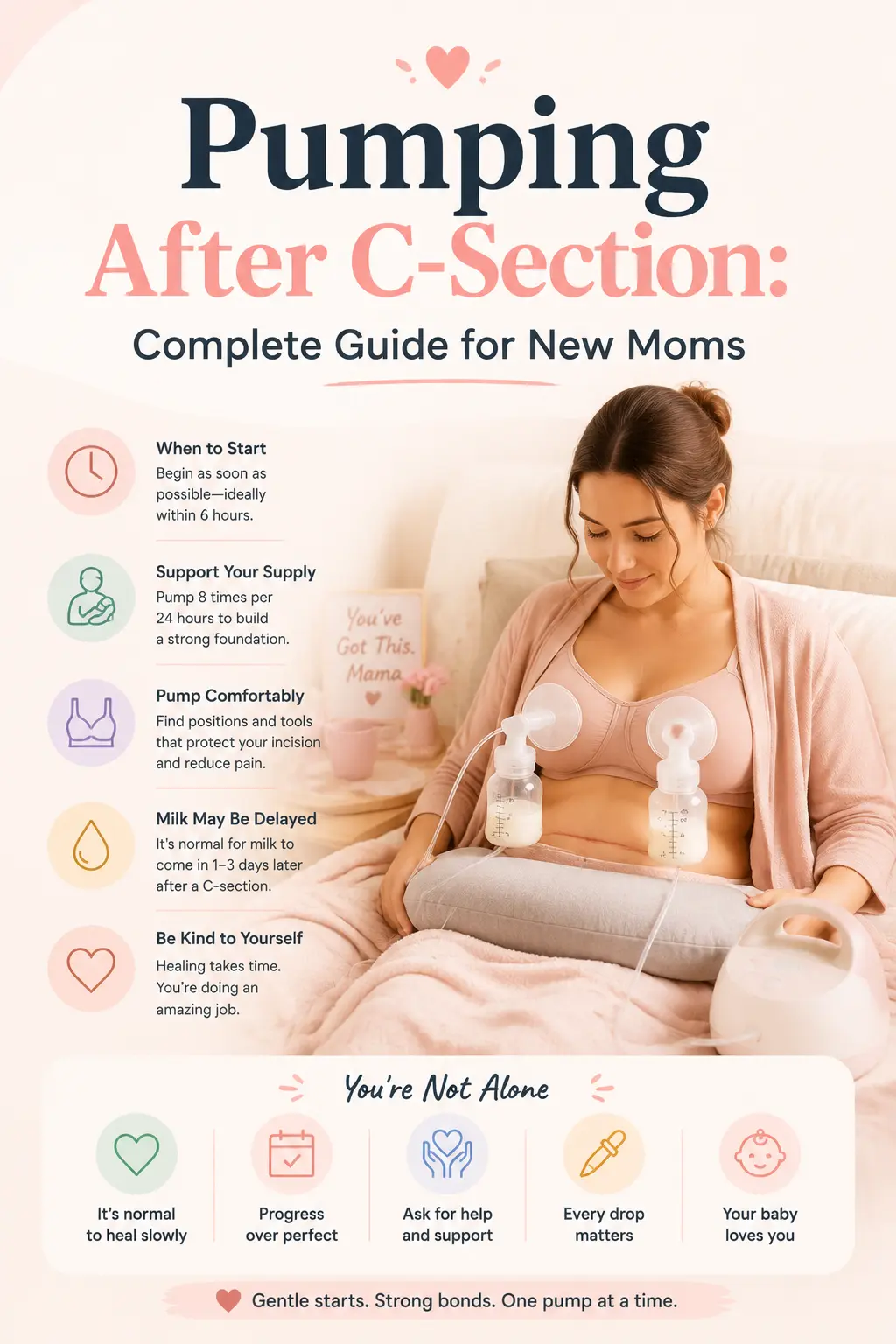
The general guidance from Stanford Medicine: start pumping as soon as possible after birth — ideally within the first 6 hours — and aim for 8 times per 24 hours with no more than a 5-hour gap at night.
In practice, this may not be possible immediately after surgery. Here's a realistic timeline:
| Timeframe | What to Do |
|---|---|
| First 1–2 hours | Skin-to-skin if possible; attempt nursing or hand expression |
| Hours 2–6 | Begin pumping if baby can't nurse; hand expression of colostrum |
| Day 1–2 | Pump 8 times per 24 hours; colostrum is normal — don't expect much volume yet |
| Day 3–5 | Milk typically comes in; volume increases; continue 8 sessions/day |
| Week 2+ | Supply establishing; maintain frequency to build supply |
If your milk hasn't come in by day 5–6, contact a lactation consultant. Early intervention makes a significant difference.
How to Pump Comfortably After a C-Section
The incision is the biggest physical challenge. Here's how to pump without aggravating it:
Positioning
- Semi-reclined: Lean back slightly rather than sitting fully upright — this reduces pressure on the incision
- Use a pillow: Place a pillow over your abdomen to protect the incision from the pump tubing or any accidental bumps
- Side-lying: Some moms find pumping while lying on their side more comfortable in the first few days
- Wearable pump: A hands-free wearable pump can be easier to manage when mobility is limited — no tubes to hold, no need to sit upright
Timing around pain medication
If you're taking pain medication, pump about 30–60 minutes after taking it — when you're most comfortable. Don't skip pain medication to pump; being in pain makes letdown harder and pumping less effective.
Most pain medications prescribed after C-section are compatible with breastfeeding. Ask your care team if you're unsure about a specific medication.
Ask for help
In the hospital, ask a nurse or lactation consultant to help you get set up for pumping. You shouldn't have to figure this out alone while recovering from major surgery.
What to Expect in the First Few Days
In the first 1–3 days, you'll produce colostrum — a thick, yellowish fluid that's small in volume but packed with antibodies and nutrients. This is normal. Don't be discouraged by the small amounts; colostrum is exactly what your newborn needs.
After a C-section, your milk may come in on day 4–5 rather than day 2–3. This is common and doesn't mean something is wrong. The key is to keep pumping frequently to signal your body to produce milk.
Signs your milk is coming in:
- Breasts feel fuller and heavier
- Increased volume when pumping
- Milk color changes from yellow/orange to white
- Baby seems more satisfied after feeding
Building Milk Supply After a C-Section
The principles for building supply after a C-section are the same as for any new mom — but frequency matters even more in the early days:
- Pump 8 times per 24 hours — this is the minimum to establish supply; more is better in the first 2 weeks
- Don't skip sessions — even if you're only getting drops, the stimulation signals your body to produce more
- Skin-to-skin contact — holding your baby skin-to-skin releases oxytocin, which helps with letdown and milk production
- Stay hydrated — you're recovering from surgery and producing milk; drink plenty of water
- Eat enough — your body needs extra calories for both recovery and milk production
If you're struggling with supply in the first week, don't wait to ask for help. A lactation consultant can assess your latch, pumping technique, and output and give personalized guidance. How to increase milk supply while pumping →
Pumping Schedule After C-Section
In the first 2 weeks, aim for:
- 8 sessions per 24 hours
- No more than 5 hours between sessions at night
- 15–20 minutes per session (or until milk stops flowing)
After 2–4 weeks, once supply is established, you can gradually adjust your schedule. Pumping schedule for newborns →
Common Concerns After C-Section Pumping
"My milk hasn't come in yet — is something wrong?"
Delayed milk after a C-section is common. Keep pumping every 2–3 hours. If milk hasn't come in by day 5–6, contact a lactation consultant or your OB.
"I'm in too much pain to pump"
Take your pain medication as prescribed — don't try to tough it out. Being in pain makes pumping harder and less effective. Ask your care team about pain management options that are compatible with breastfeeding.
"My baby is in the NICU — how do I pump?"
If your baby needs NICU care after a C-section, pumping is even more important. Start as soon as possible, pump 8+ times per day, and ask the NICU team for a hospital-grade pump. Pumping for a premature baby: NICU guide →
"Can I use a wearable pump after a C-section?"
Yes — a wearable pump can actually be easier to use after a C-section because it doesn't require you to hold anything or sit in a specific position. Make sure the pump doesn't press on your incision area.
Tracking Your Output After C-Section
After a C-section, it's especially important to track your pumping sessions and output. You want to know:
- When your milk came in (the day output increases significantly)
- Whether your output is increasing day by day
- Whether you're hitting your 8 sessions per day
Log every session with Piaora to track your progress and catch any supply issues early. Try our free Pumping Tracker →
Final Thoughts
A C-section adds complexity to the early days of pumping — but it doesn't make breastfeeding impossible. The most important things are to start early, pump frequently, and ask for help when you need it.
Be patient with yourself. You're recovering from major surgery while also trying to establish milk supply for a newborn. That's a lot. Give yourself grace, focus on the fundamentals, and know that delayed milk after a C-section is common and manageable.
Related Articles
Written by
Piaora Editorial Team
Evidence-based guides on pumping, breastfeeding, and PCOS — researched with input from lactation professionals and written for real moms.
Learn more about our team and editorial standards →