How to Drop a Pumping Session Without Losing Supply
Whether you're pumping 8 times a day and exhausted, returning to a more normal schedule, or starting the gradual process of weaning — at some point, most pumping moms want to pump less. The challenge is doing it without tanking your supply or ending up with a painful clog or mastitis.
Here's how to drop a pumping session safely, step by step.
When Is It Safe to Drop a Pumping Session?
The right time to reduce pumping frequency depends on your goals and your baby's age. The American Academy of Pediatrics notes that supply regulation takes about 12 weeks to fully establish:
- Before 12 weeks: Supply is still establishing — dropping sessions too early can cause a significant and hard-to-recover drop. Wait until supply is stable and predictable before reducing.
- After 12 weeks: Supply is more established and generally more resilient. Most moms can begin gradually reducing sessions.
- When your baby starts solids (around 6 months): As your baby takes more food, you can naturally reduce pumping to match their decreased milk intake.
- When weaning: Gradual reduction is key to avoiding mastitis and engorgement.
Signs your supply is stable enough to consider dropping a session:
- Your output is consistent from day to day
- You're producing more than your baby needs (building a stash)
- Your baby is gaining weight well and seems satisfied
The Golden Rule: Drop One Session at a Time
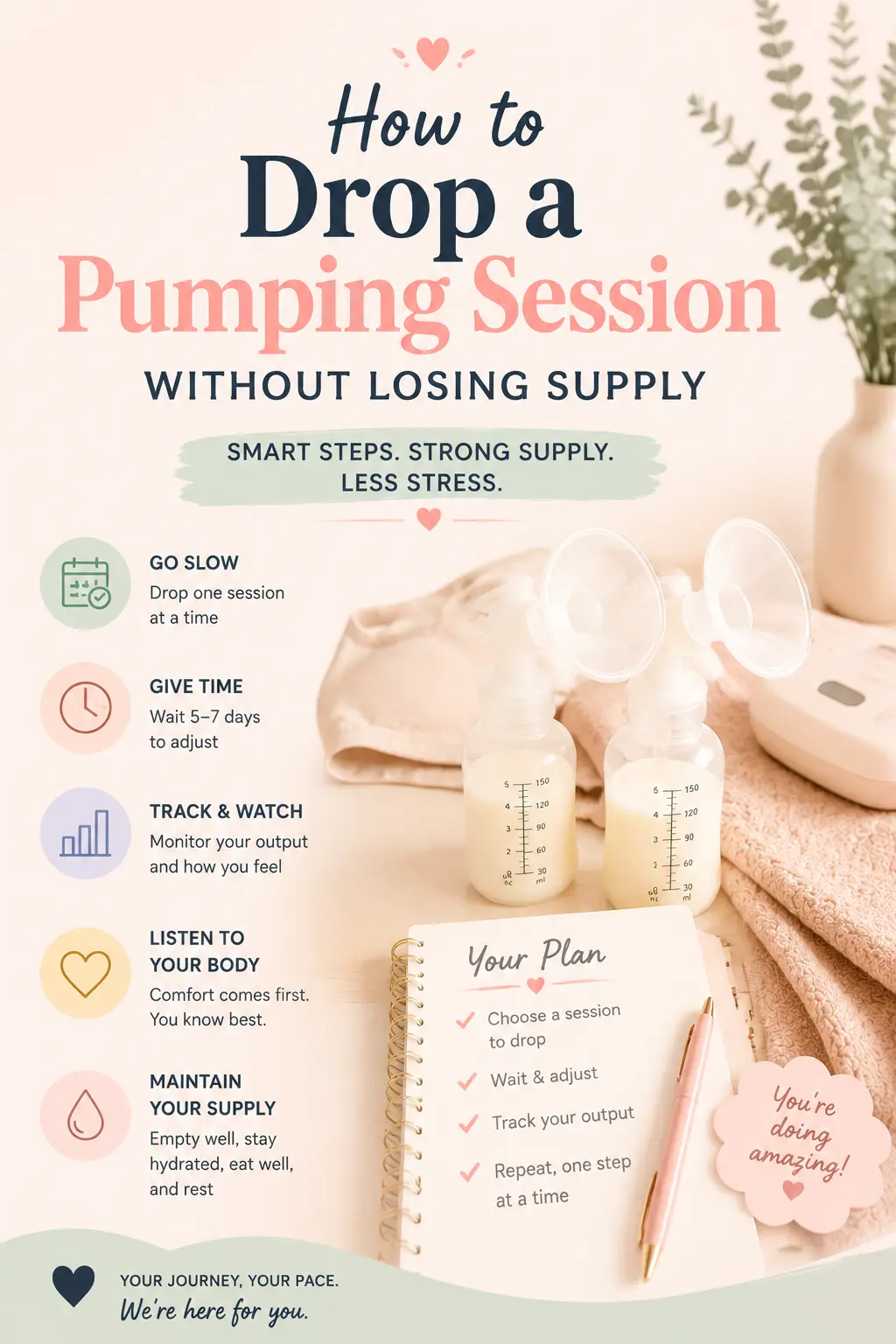
Never drop two sessions at once. Your body needs time to adjust to the reduced demand — typically 5–7 days per session dropped. Dropping too fast leads to engorgement, clogged ducts, and mastitis.
The process:
- Choose one session to eliminate
- Wait 5–7 days while your body adjusts
- Monitor your output and comfort
- Once stable, drop the next session if desired
Which Pumping Session to Drop First
Not all sessions are equal. Drop the session that will have the least impact on your supply:
Drop the middle-of-the-night session first
The MOTN (middle of the night) session is often the hardest to maintain and the one moms most want to drop. Prolactin levels are highest at night, so this session does support supply — but it's also the most disruptive to sleep.
If you're pumping 7–8 times a day and want to drop to 6, the MOTN session is usually the first to go. Your body will adjust, though you may see a small temporary dip in output. Pumping at night: should you do it? →
Drop your lowest-output session
Look at your pumping log and identify which session consistently produces the least milk. This is usually a session later in the day when supply naturally dips. Dropping your lowest-output session has the smallest impact on your total daily output.
This is where tracking your sessions pays off — without data, you're guessing. Track your sessions with Piaora →
Don't drop the morning session last
The morning session (first pump of the day) is typically your highest-output session due to overnight prolactin buildup. Keep this one until you're ready to stop pumping entirely.
How to Drop a Session: Step-by-Step
Option 1: Cold turkey (drop the session completely)
Simply stop pumping at that time. Your body will gradually stop producing milk for that session. You may feel full or uncomfortable for a few days — this is normal. Don't pump to relieve the pressure (this signals your body to keep producing), but you can hand express a small amount if you're very uncomfortable.
Option 2: Gradual reduction (reduce session length or output)
Instead of dropping the session entirely, gradually shorten it or reduce the amount you pump:
- Week 1: Pump for 10 minutes instead of 15–20
- Week 2: Pump for 5 minutes
- Week 3: Skip the session entirely
This gentler approach is better for moms prone to clogged ducts or mastitis, or those with oversupply.
What to Expect After Dropping a Session
In the first few days after dropping a session, you may notice:
- Fullness or engorgement at the time you used to pump — this is normal and will resolve in 3–5 days
- A temporary dip in total daily output — your body is recalibrating; output usually stabilizes within a week
- Slight discomfort — manageable with a cold pack or cabbage leaves if needed
If you experience significant pain, a hard lump, or flu-like symptoms, these could be signs of a clogged duct or mastitis. Don't ignore these — pump or nurse to clear the blockage and contact your doctor if symptoms worsen. How to prevent mastitis while pumping →
How Many Times a Day Should You Pump?
General guidelines by stage:
| Baby's Age | Recommended Sessions/Day | Notes |
|---|---|---|
| 0–4 weeks | 8–12 times | Establishing supply — don't drop sessions |
| 1–3 months | 7–8 times | Supply stabilizing; can consider dropping MOTN |
| 3–6 months | 5–7 times | Can gradually reduce if supply is established |
| 6–12 months | 3–5 times | Baby starting solids; can reduce further |
| Weaning | 1–2 times → 0 | Drop one session every 1–2 weeks |
These are guidelines, not rules. Every mom's supply responds differently. Use your output data to guide decisions.
Dropping Sessions While Maintaining Supply for Your Baby
If you're dropping sessions but still need to produce enough milk for your baby, the key is to make sure your remaining sessions are as effective as possible:
- Pump until empty at each remaining session — don't cut sessions short
- Use breast massage and compression during pumping to maximize output
- Stay hydrated and eat enough calories
- Consider power pumping once a week if you notice supply dropping more than expected
Power pumping guide: how to boost supply fast →
Tracking Your Output Through the Transition
The most important thing when dropping sessions is to track your output carefully. You want to know:
- Your total daily output before dropping the session
- How your output changes in the days after
- Whether your output stabilizes at an acceptable level
Without tracking, you're flying blind. Log every session with Piaora to see your trends and make informed decisions about when to drop the next session. Try our free Pumping Tracker →
Signs You Dropped a Session Too Fast
- Total daily output dropped by more than 20% and hasn't recovered after a week
- Your baby seems unsatisfied or is not gaining weight well
- You're experiencing frequent clogged ducts
- You developed mastitis
If this happens, add the session back temporarily and try again more gradually.
Final Thoughts
Dropping a pumping session is a normal part of the pumping journey — whether you're reducing from 8 sessions to 6, or gradually weaning entirely. The key is patience: one session at a time, with enough time between each drop for your body to adjust.
Use your data. Track your output before, during, and after each change. Your numbers will tell you whether your body has adjusted and whether it's safe to drop the next session.
For a complete guide to building and adjusting your pumping schedule: How to build a personalized pumping schedule →
Track your output through every transition with our free Pumping Tracker.
Learn more about Pumping Tracker →Related Articles



Written by
Piaora Editorial Team
Evidence-based guides on pumping, breastfeeding, and PCOS — researched with input from lactation professionals and written for real moms.
Learn more about our team and editorial standards →