Pumping Schedule for Newborns: How Often and How Long
The first few weeks after birth are the most critical time for establishing your milk supply. Whether you're exclusively pumping, supplementing breastfeeding, or pumping because your baby is in the NICU, getting your newborn pumping schedule right sets the foundation for everything that follows.
This article is specifically about the first 0-6 weeks. For returning to work after newborn stage, see Pumping Schedule for Working Moms. For creating a flexible long-term plan, see How to Build a Personalized Pumping Schedule.
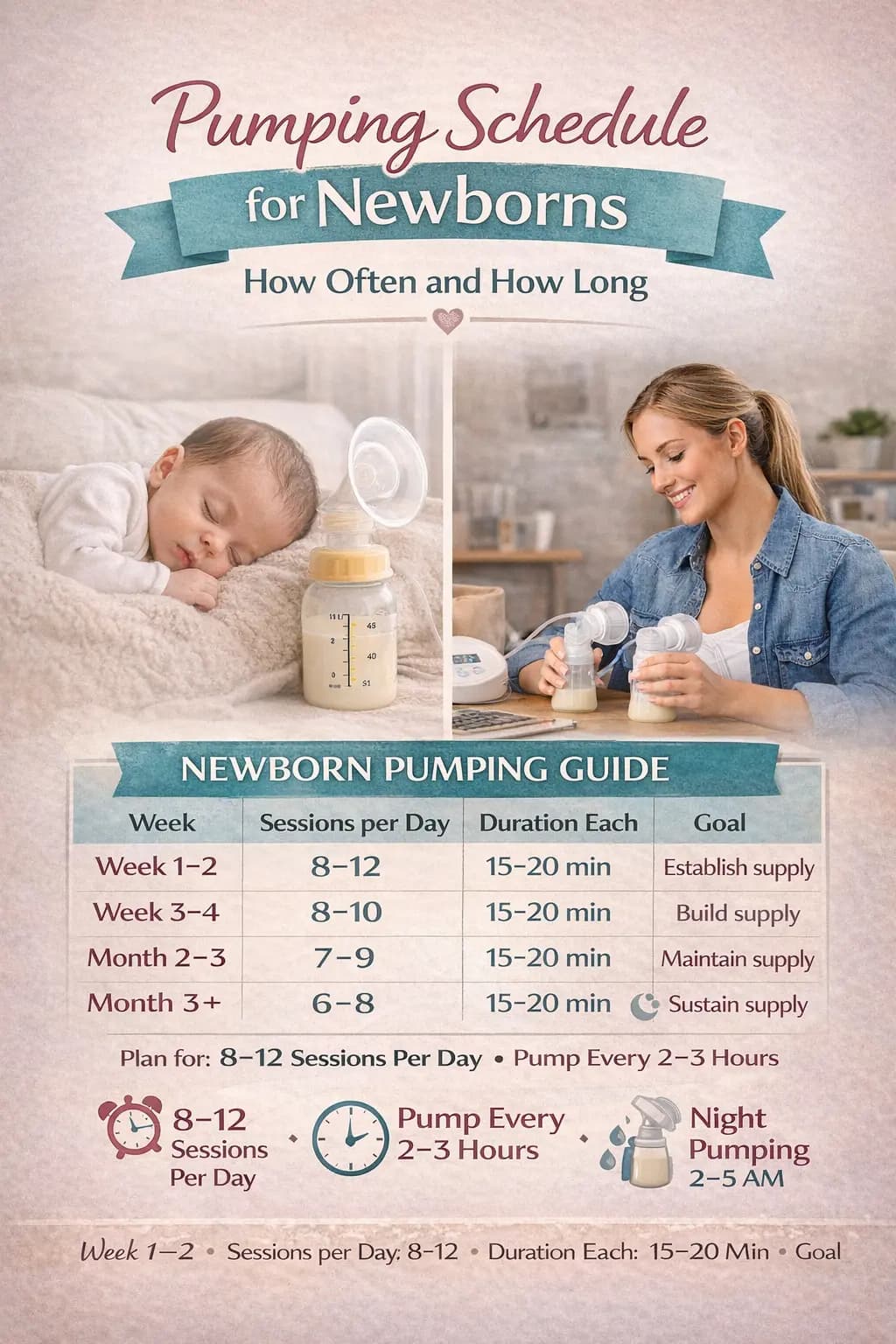
How Often Should You Pump for a Newborn? (Quick Answer)
Pump 8–12 times per 24 hours in the first few weeks. According to the La Leche League, this mimics how often a newborn feeds and sends the strongest possible signal to your body to produce milk.
| Week | Sessions per Day | Duration Each | Goal |
|---|---|---|---|
| Week 1–2 | 8–12 | 15–20 min | Establish supply |
| Week 3–4 | 8–10 | 15–20 min | Build supply |
| Month 2–3 | 7–9 | 15–20 min | Maintain supply |
| Month 3+ | 6–8 | 15–20 min | Sustain supply |
Why the First Two Weeks Are Critical
Your body doesn't know how much milk to make — it learns from demand. In the first 2 weeks, frequent stimulation tells your body to produce enough milk for your baby.
This window is called the supply establishment period. What you do now directly determines your long-term supply capacity. Moms who pump frequently in the first 2 weeks consistently have higher supply at 3 and 6 months.
The most common mistake: pumping too infrequently in week 1 because you're exhausted and recovering. Understandable — but it's the hardest supply deficit to recover from.
Sample Newborn Pumping Schedule (24 Hours)
Here's what 8–10 sessions spread across 24 hours looks like. You can also use our free Pumping Schedule Generator to build a personalized schedule based on your wake time and daily routine:
| Time | Session |
|---|---|
| 6:00 AM | Session 1 (morning — highest output) |
| 8:30 AM | Session 2 |
| 11:00 AM | Session 3 |
| 1:30 PM | Session 4 |
| 4:00 PM | Session 5 |
| 6:30 PM | Session 6 |
| 9:00 PM | Session 7 |
| 11:30 PM | Session 8 |
| 2:00 AM | Session 9 (night — prolactin peak) |
| 4:30 AM | Session 10 (optional) |
You don't need to follow exact times — aim for sessions roughly every 2–3 hours, with no gap longer than 4–5 hours during the day and one session between midnight and 5 AM.
Do You Need to Pump at Night for a Newborn?
Yes — especially in the first 4–6 weeks. Night pumping is essential for newborns because:
- Prolactin peaks between 2–4 AM — the most supply-building session of the day
- Going 6+ hours without pumping in the early weeks can cause supply to drop quickly
- Your body is still learning how much milk to make — every session counts
Once your supply is established (usually around 6–8 weeks), you can gradually drop the night session. When can you stop pumping at night? →
How Much Milk Should You Expect in the First Week?
New moms are often alarmed by how little they pump in the first few days. This is completely normal:
- Days 1–3: Colostrum only — you may pump just a few drops to 5ml per session. This is normal and expected.
- Days 3–5: Milk "comes in" — output increases noticeably
- Week 2: Supply continues to build with consistent pumping
- Week 3–4: Supply should be more established and predictable
Don't judge your supply by first-week output. Judge it by whether you're pumping consistently.
If You're Also Breastfeeding: Key Rules
If you're combining nursing and pumping, the rules are slightly different:
- Breastfeed first, then pump — your baby is more efficient than any pump
- Pump after nursing sessions to signal additional demand
- Total sessions (nursing + pumping) should still reach 8–12 per day
How to combine breastfeeding and pumping →
Tips for Surviving the Newborn Pumping Stage
- Set alarms — sleep deprivation makes it easy to miss sessions
- Keep pump parts accessible — set up a dedicated pumping station
- Track every session — output data helps you see progress and catch problems early
- Ask for help — partner, family, or postpartum support can make a huge difference
- Be patient — supply takes 4–6 weeks to fully establish. Don't give up in week 1.
Final Thoughts
The newborn pumping stage is the hardest — you're recovering from birth, sleep-deprived, and learning everything at once. But the effort you put in during these first weeks pays off for months.
Pump consistently, track your sessions, and trust the process. Your supply will build.
When you return to work, your schedule will need to adjust. Pumping schedule for working moms returning to work →
Track every newborn pumping session and watch your supply build over time.
Learn more about Pumping Tracker →Related Articles



Written by
Piaora Editorial Team
Evidence-based guides on pumping, breastfeeding, and PCOS — researched with input from lactation professionals and written for real moms.
Learn more about our team and editorial standards →