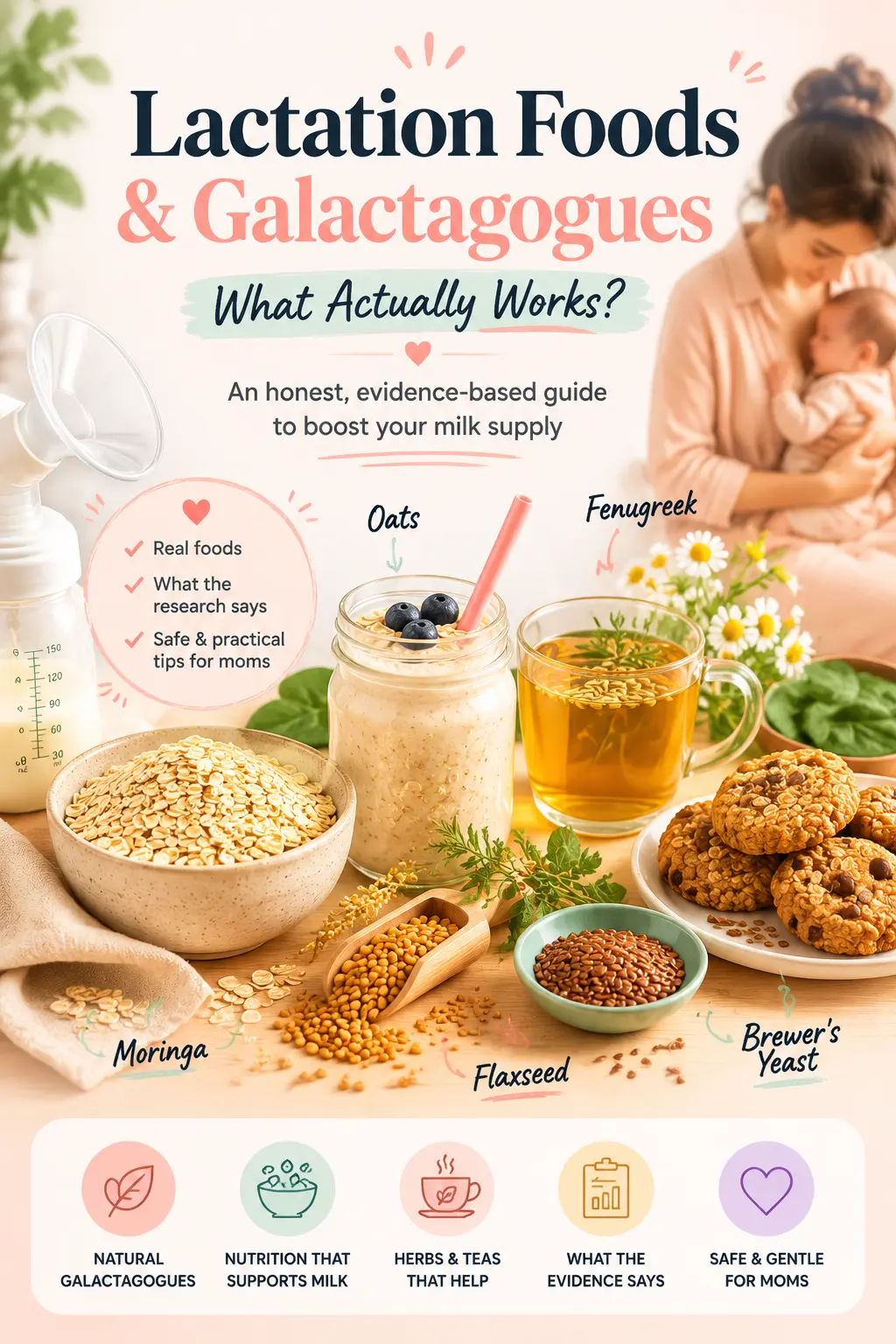
Lactation Foods & Galactagogues: What Actually Works?
You've probably heard that oatmeal boosts milk supply, or that fenugreek tea is a must-have for pumping moms. Lactation cookies, special teas, and herbal supplements are everywhere — and when you're worried about supply, it's tempting to try all of them.
But what does the evidence actually say? Here's an honest, research-based look at galactagogues — what they are, which ones have the most support, and what matters more than any single food.
How this article differs: This is a science-focused review of individual galactagogues ranked by research quality. For a simpler daily eating plan and general breastfeeding nutrition tips, see our What to Eat to Increase Milk Supply guide.
What Are Galactagogues?
A galactagogue (pronounced gah-LAK-tah-gog) is any food, herb, or medication believed to increase breast milk production. The word comes from the Greek galakt (milk) and agogos (leading or promoting).
Galactagogues fall into two categories:
- Natural galactagogues — foods and herbs like oats, fenugreek, fennel, moringa, and brewer's yeast
- Pharmaceutical galactagogues — prescription medications like domperidone or metoclopramide, used in specific medical situations
This article focuses on natural lactation foods and herbal galactagogues — the ones you'll find in lactation cookies, teas, and supplements.
The Honest Truth About Lactation Foods
Before diving into specific foods, it's important to be upfront: the scientific evidence for most natural galactagogues is limited. A 2016 review published in Ochsner Journal found that while some herbs show promise, high-quality clinical trials are lacking for most.
This doesn't mean these foods don't work — it means we don't have strong proof either way. Many moms report real results with certain foods, and centuries of traditional use across cultures carry weight even without clinical trials.
The most important factors for milk supply are frequent, effective milk removal (pumping or nursing often and completely) and adequate hydration and calories. No food will compensate for infrequent pumping or severe caloric restriction. How to increase milk supply while pumping →
Oats (Oatmeal)
Oatmeal is probably the most widely recommended lactation food, and it's one of the more plausible ones. Oats are rich in iron, and low iron levels are associated with reduced milk supply. They also contain beta-glucan, a type of soluble fiber that may stimulate prolactin (the hormone responsible for milk production).
Evidence: Mostly anecdotal and traditional, but the nutritional profile is genuinely supportive. Many lactation consultants recommend oats as a safe, nutritious addition to a pumping mom's diet.
How to use: A bowl of oatmeal in the morning is the simplest approach. Steel-cut or rolled oats are preferable to instant oats, which are more processed. Oat-based lactation cookies and bars also count.
Fenugreek
Fenugreek is the most studied herbal galactagogue. It's been used for centuries across South Asia, the Middle East, and North Africa to support milk production. Some small clinical trials have shown positive results — one study found that mothers who consumed fenugreek saw improvements in infant weight gain and urination frequency in the first week.
Evidence: More research than most herbs, but still limited. The NIH LactMed database notes that fenugreek is widely used but evidence is inconsistent.
Important caveats:
- Some moms report that fenugreek decreases their supply — the response varies significantly between individuals
- It can cause a maple syrup smell in urine and sweat (and in your baby's urine)
- Not recommended if you have diabetes or thyroid conditions without consulting a doctor
- Avoid during pregnancy — it can stimulate uterine contractions
How to use: Fenugreek capsules (500–600mg, 2–3 times daily) are the most common form. Some moms use fenugreek tea or add seeds to cooking.
Fennel
Fennel (the vegetable, seeds, and essential oil) contains phytoestrogens — plant compounds that mimic estrogen — which may support prolactin production. It's been used as a galactagogue in Mediterranean and Middle Eastern cultures for centuries.
Evidence: Limited clinical evidence, but generally considered safe in food amounts. Fennel seed tea is a common traditional remedy.
How to use: Add fennel to cooking, drink fennel seed tea, or use fennel-containing lactation teas. Avoid high-dose fennel essential oil — it can be toxic in large amounts.
Moringa (Malunggay)
Moringa is a leafy green vegetable widely used in the Philippines and other parts of Asia as a lactation food. It's exceptionally nutrient-dense — high in protein, iron, calcium, and vitamins A and C. A small randomized controlled trial found that moringa supplementation significantly increased milk volume compared to placebo.
Evidence: One of the better-studied natural galactagogues, with at least one positive RCT. Growing interest in Western lactation communities.
How to use: Moringa powder can be added to smoothies, soups, or taken as capsules. Moringa leaves can be cooked into dishes.
Brewer's Yeast
Brewer's yeast is a common ingredient in lactation cookies and bars. It's rich in B vitamins, iron, protein, and chromium. The theory is that its nutritional density supports overall health and energy, which indirectly supports milk production.
Evidence: Mostly anecdotal. No strong clinical trials specifically for milk supply, but it's nutritionally dense and generally safe.
How to use: Most commonly found in lactation cookie recipes. Can also be added to smoothies or taken as a supplement.
Flaxseed
Flaxseeds contain phytoestrogens (lignans) and omega-3 fatty acids. They're often included in lactation cookies and bars alongside oats and brewer's yeast.
Evidence: Limited specific evidence for milk supply, but omega-3s are important for breast milk quality and maternal health.
How to use: Ground flaxseed (not whole) added to oatmeal, smoothies, or baked goods. Ground flaxseed is better absorbed than whole seeds.
Garlic
Garlic has been used as a galactagogue in many cultures. Some research suggests that babies nurse longer when their mothers have eaten garlic — possibly because they prefer the flavor of garlic-scented milk. This increased nursing time could stimulate more milk production.
Evidence: Small studies, mostly focused on infant feeding behavior rather than direct milk volume. Generally safe in food amounts.
What About Lactation Cookies and Teas?
Lactation cookies typically combine several galactagogues — oats, brewer's yeast, flaxseed — into a convenient (and delicious) format. They're not magic, but they're a practical way to get multiple potentially supportive ingredients at once.
Lactation teas often contain fenugreek, fennel, blessed thistle, and other herbs. They're generally safe in moderate amounts, but check ingredients if you have any health conditions or are taking medications.
The honest take: If lactation cookies make you feel good and you enjoy them, great. But don't rely on them as a substitute for frequent pumping or addressing underlying supply issues.
Foods That May Decrease Milk Supply
Just as some foods may support supply, others are believed to reduce it:
- Peppermint and spearmint — large amounts (like peppermint tea or peppermint oil) may reduce supply; small amounts in food are generally fine
- Sage — traditionally used to dry up milk supply; avoid large amounts while breastfeeding
- Parsley — in large amounts, may reduce supply
- Alcohol — inhibits the milk ejection reflex and can temporarily reduce output
What Actually Matters Most for Milk Supply
No galactagogue will compensate for the fundamentals. The most evidence-backed ways to support and increase milk supply:
- Pump or nurse frequently — 8–12 times per day in the early weeks; supply is driven by demand
- Empty the breast completely — residual milk signals your body to make less
- Stay hydrated — aim for at least 8–10 cups of water per day
- Eat enough calories — breastfeeding burns 300–500 extra calories per day; undereating suppresses supply
- Manage stress — cortisol inhibits oxytocin, which is needed for milk letdown
- Get enough sleep — prolactin levels are highest during sleep
7 proven ways to increase milk supply while pumping →
Complete guide to what to eat to increase milk supply →
Tracking Whether Galactagogues Are Working
If you try a new food or supplement, the only way to know if it's helping is to track your output consistently. Log your pump sessions before and after introducing a galactagogue — if your output increases over 1–2 weeks, it may be helping. If it doesn't change, it's probably not the right fit for you.
Track your sessions and output with Piaora to see your trends clearly. Try our free Pumping Tracker →
Summary: Lactation Foods Ranked by Evidence
| Food / Herb | Evidence Level | Notes |
|---|---|---|
| Moringa | Moderate | Positive RCT; nutrient-dense |
| Fenugreek | Mixed | Most studied; response varies; some moms see decrease |
| Oats | Anecdotal + nutritional | Iron-rich; widely recommended; safe |
| Fennel | Traditional | Phytoestrogens; safe in food amounts |
| Brewer's yeast | Anecdotal | Nutritionally dense; common in lactation cookies |
| Flaxseed | Anecdotal | Good for omega-3s; use ground form |
| Garlic | Limited | May increase nursing duration; safe in food amounts |
The bottom line: galactagogues are worth trying if you're already doing the fundamentals right. They're not a shortcut, but they're also not snake oil. Start with the most evidence-backed options (moringa, oats), track your output, and see what works for your body.
Track your output to see if lactation foods are making a difference.
Learn more about Pumping Tracker →Related Articles



Written by
Piaora Editorial Team
Evidence-based guides on pumping, breastfeeding, and PCOS — researched with input from lactation professionals and written for real moms.
Learn more about our team and editorial standards →