Breast Milk Jaundice: What Parents Need to Know
Your newborn has jaundice, and someone has suggested you stop breastfeeding. Before you do — read this.
Breast milk jaundice is real, but it's also frequently misunderstood and over-treated. Most cases resolve on their own without stopping breastfeeding. This guide explains what's actually happening, what the evidence says, and when you genuinely need to be concerned.
Important: This article is for informational purposes only. Always follow your pediatrician's guidance for your specific baby.
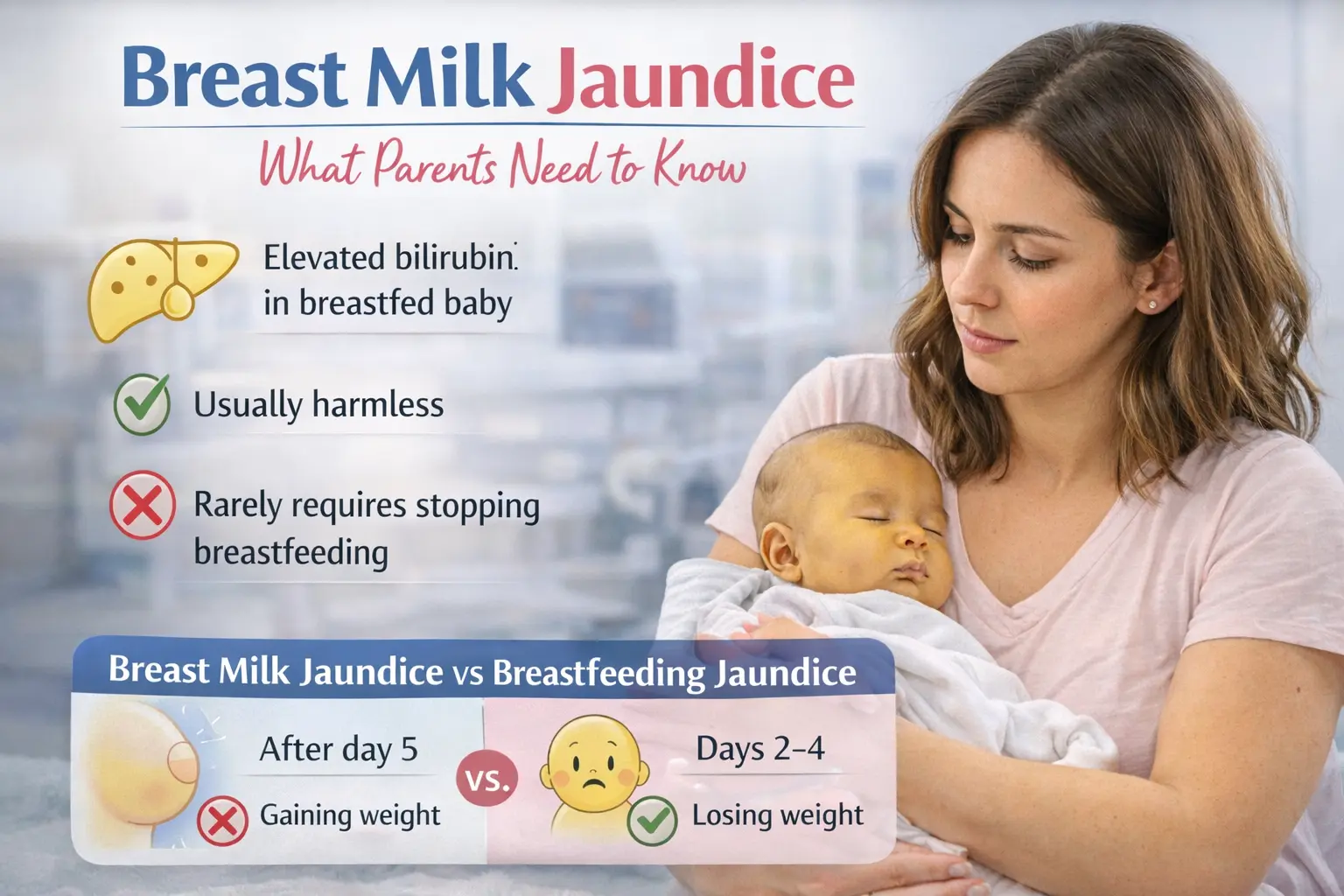
What Is Breast Milk Jaundice? (Quick Answer)
Breast milk jaundice is a prolonged form of jaundice in newborns that is associated with breastfeeding. It typically appears after the first week of life and can last several weeks or even months — but in most cases, it's harmless and resolves on its own.
It's caused by substances in breast milk that increase the reabsorption of bilirubin in the intestines. The exact mechanism isn't fully understood, but it's considered a normal variation — not a disease.
Breast Milk Jaundice vs Breastfeeding Jaundice: The Critical Difference
These are two different conditions that are often confused:
| Feature | Breastfeeding Jaundice | Breast Milk Jaundice |
|---|---|---|
| When it appears | Days 2–4 | Days 5–7 or later |
| Cause | Insufficient milk intake / dehydration | Substances in breast milk |
| Baby's weight | Often losing weight | Gaining weight normally |
| Treatment | Feed more frequently, improve latch | Usually none needed |
| Stop breastfeeding? | No — feed MORE | Rarely necessary |
| Duration | Resolves with better feeding | Can last 3–12 weeks |
Breastfeeding jaundice is caused by not getting enough milk — the solution is to feed more, not less. Breast milk jaundice is caused by something in the milk itself — and in most cases, no treatment is needed.
Is Breast Milk Jaundice Dangerous?
In the vast majority of cases, no. Breast milk jaundice is considered a benign condition. Bilirubin levels are typically mild to moderate and don't reach dangerous levels.
However, very high bilirubin levels — regardless of cause — can be dangerous. This is why your pediatrician monitors bilirubin levels and why you should follow their guidance.
Signs that require immediate medical attention:
- Extreme yellowing of skin and whites of eyes
- Baby is very difficult to wake or unusually lethargic
- High-pitched crying
- Arching of the back
- Bilirubin levels above your doctor's threshold
Do You Need to Stop Breastfeeding?
In most cases of breast milk jaundice: no.
The American Academy of Pediatrics (AAP) states that breastfeeding should be continued in most cases of breast milk jaundice. The benefits of breast milk far outweigh the risks of mild to moderate jaundice.
In rare cases where bilirubin levels are very high, a doctor may recommend a brief interruption of breastfeeding (24–48 hours) while pumping to maintain supply. This is uncommon and should only be done under medical supervision.
If you do need to temporarily pause breastfeeding, pump every 2–3 hours to protect your supply. How often to pump to maintain supply →
How Long Does Breast Milk Jaundice Last?
Breast milk jaundice typically:
- Peaks around 2 weeks of age
- Gradually improves over 3–12 weeks
- Resolves completely by 3 months in most cases
The slow resolution can be alarming for parents, but it's normal. As long as your baby is feeding well, gaining weight, and bilirubin levels are within safe range, continued monitoring is usually all that's needed.
What You Can Do
- Keep breastfeeding or pumping — unless your doctor specifically advises otherwise
- Feed frequently — 8–12 times per day helps clear bilirubin through stool. Newborn pumping schedule →
- Attend all follow-up appointments — bilirubin monitoring is important
- Track feeding sessions — helps you ensure your baby is getting enough milk
- Ask questions — if you're told to stop breastfeeding, ask why and what the bilirubin level is
Final Thoughts
Breast milk jaundice sounds scary — but in most cases, it's a normal variation that resolves on its own. The evidence strongly supports continuing to breastfeed or pump through it.
If you're ever unsure, ask your pediatrician for the specific bilirubin number and what threshold would require intervention. Knowledge is your best tool.
Track your pumping sessions to ensure consistent milk removal during this time.
Learn more about Pumping Tracker →Related Articles

Written by
Piaora Editorial Team
Evidence-based guides on pumping, breastfeeding, and PCOS — researched with input from lactation professionals and written for real moms.
Learn more about our team and editorial standards →