Pumping at Work Laws: Your Legal Rights as a Breastfeeding Mom
Many working moms don't know they have legal protections for pumping at work — or they know the law exists but aren't sure what it actually requires. This guide explains your rights clearly, so you can advocate for yourself with confidence.
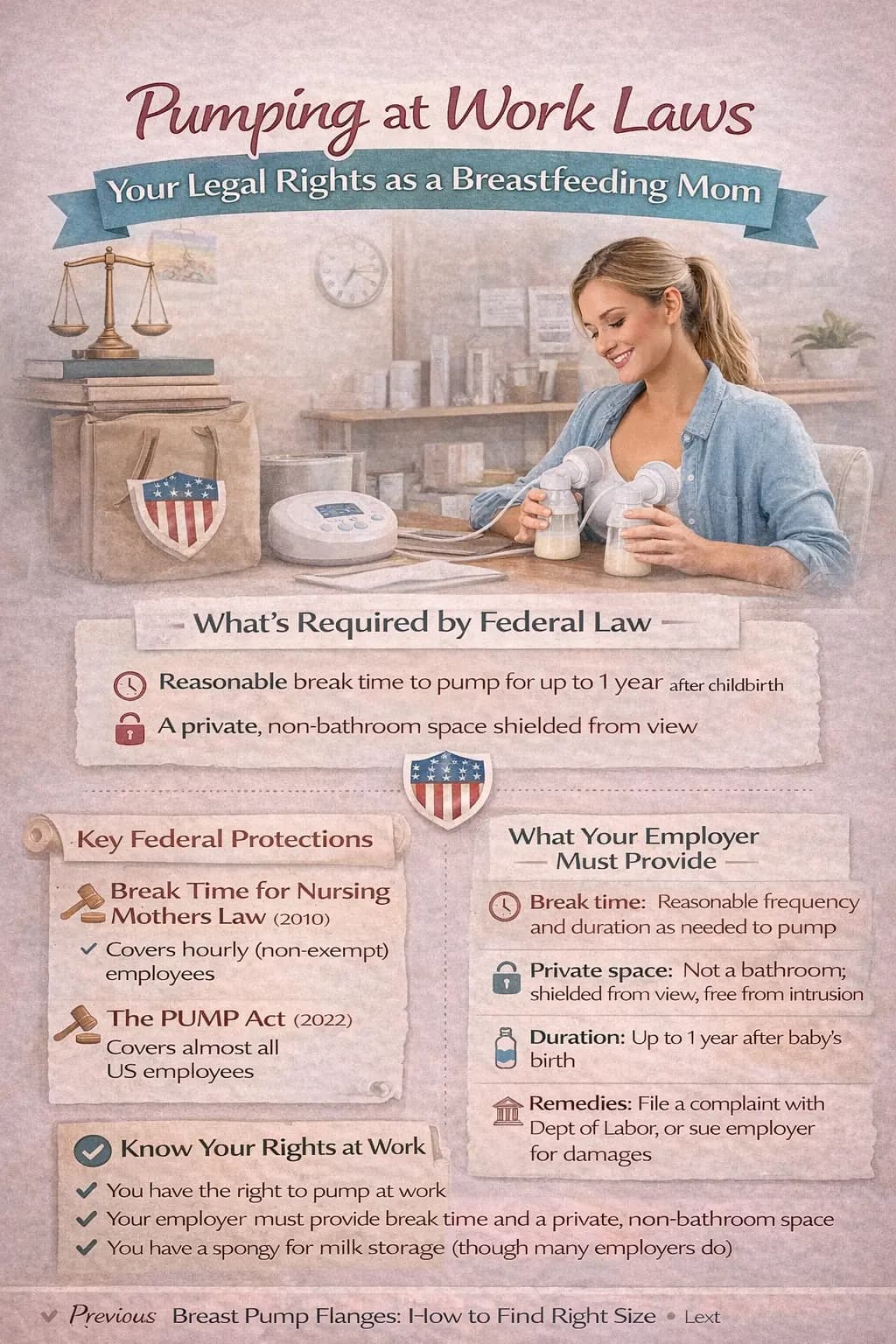
Note: This article focuses on US federal law. State laws may provide additional protections. Always consult an employment attorney for advice specific to your situation.
What Are Your Legal Rights? (Quick Answer)
Under US federal law, most employers are required to provide:
- Reasonable break time to pump for up to 1 year after your baby's birth
- A private space that is not a bathroom and is shielded from view
These protections apply to most employees in the United States under two federal laws: the Break Time for Nursing Mothers provision and the newer PUMP for Nursing Mothers Act (signed into law December 2022).
The Break Time for Nursing Mothers Law
Originally passed as part of the Affordable Care Act in 2010, this law amended the Fair Labor Standards Act (FLSA) to require employers to provide:
- Reasonable unpaid break time for nursing employees to express milk
- A private location — not a bathroom — that is free from intrusion
Originally, this only covered hourly (non-exempt) employees. The PUMP Act expanded these protections significantly.
The PUMP Act (2022): What Changed
The Providing Urgent Maternal Protections for Nursing Mothers (PUMP) Act was signed into law in December 2022 and expanded pumping protections to cover nearly all employees, including:
- Salaried (exempt) employees — previously excluded
- Teachers, nurses, and other workers previously exempt from the original law
- Airline crew members (with some limitations)
Key additions under the PUMP Act:
- Employees can now sue employers who violate these rights
- Remedies include back pay, compensatory damages, and attorney fees
- Employers must notify employees of their rights
What Your Employer Must Provide
| Requirement | Details |
|---|---|
| Break time | Reasonable frequency and duration as needed to pump |
| Private space | Not a bathroom; shielded from view; free from intrusion |
| Duration | Up to 1 year after baby's birth |
| Pay | Breaks may be unpaid unless employer pays other breaks |
What Your Employer Does NOT Have to Provide
The law has limits. Your employer is not required to:
- Pay you for pumping breaks (unless they pay for other breaks of similar length)
- Provide a dedicated lactation room — a temporary private space is sufficient
- Provide a refrigerator for milk storage (though many employers do)
- Allow you to pump at your desk if it's not private
Small Employer Exception
Employers with fewer than 50 employees may be exempt if they can demonstrate that compliance would cause "undue hardship." However, this exemption is narrow — the employer must prove significant difficulty or expense, not just inconvenience.
Many states have laws that cover small employers too. Check your state's specific laws for additional protections.
What to Do If Your Employer Isn't Complying
If your employer is not providing required accommodations:
- Document everything — keep records of requests made and responses received
- Talk to HR — many violations are due to ignorance, not malice
- File a complaint with the Department of Labor — the Wage and Hour Division enforces FLSA pumping provisions
- Consult an employment attorney — the PUMP Act allows you to sue for damages
State Laws: Additional Protections
Many states have laws that go beyond federal requirements:
- Some states require paid pumping breaks
- Some cover employers with fewer than 50 employees
- Some extend protections beyond 1 year
- Some require employers to provide refrigerators for milk storage
Check your state's Department of Labor website or the National Conference of State Legislatures (NCSL) for state-specific laws.
Practical Tips for Pumping at Work
Knowing your rights is the first step. Making pumping at work actually work is the next. How often should you pump at work? →
And if you're just returning to work: Pumping schedule for working moms returning to work →
Know Before You Go Back: Quick Summary
| What You Have | Details |
|---|---|
| Break time | Reasonable frequency and duration, as needed to pump |
| Private space | Not a bathroom, shielded from view, free from intrusion |
| Duration | Up to 1 year after your baby's birth |
| Coverage | Most US employees under PUMP Act (2022) |
| If violated | File with Dept of Labor or sue for damages |
| State laws | May provide additional protections — check your state |
Final Thoughts
You have legal rights. Your employer is required to support your pumping — not just tolerate it. Knowing the law gives you the confidence to ask for what you need without apology.
If you're facing pushback at work, document everything and don't hesitate to escalate. The law is on your side.
Stay consistent with your pumping schedule at work — track every session with our free app.
Learn more about Pumping Tracker →Related Articles
Written by
Piaora Editorial Team
Evidence-based guides on pumping, breastfeeding, and PCOS — researched with input from lactation professionals and written for real moms.
Learn more about our team and editorial standards →