How Long Should a Pumping Session Last?
One of the most common questions new pumping moms ask — and one that surprisingly few guides answer clearly. Pump too short and you leave milk behind. Pump too long and you waste time without extra benefit.
Here's what you actually need to know.
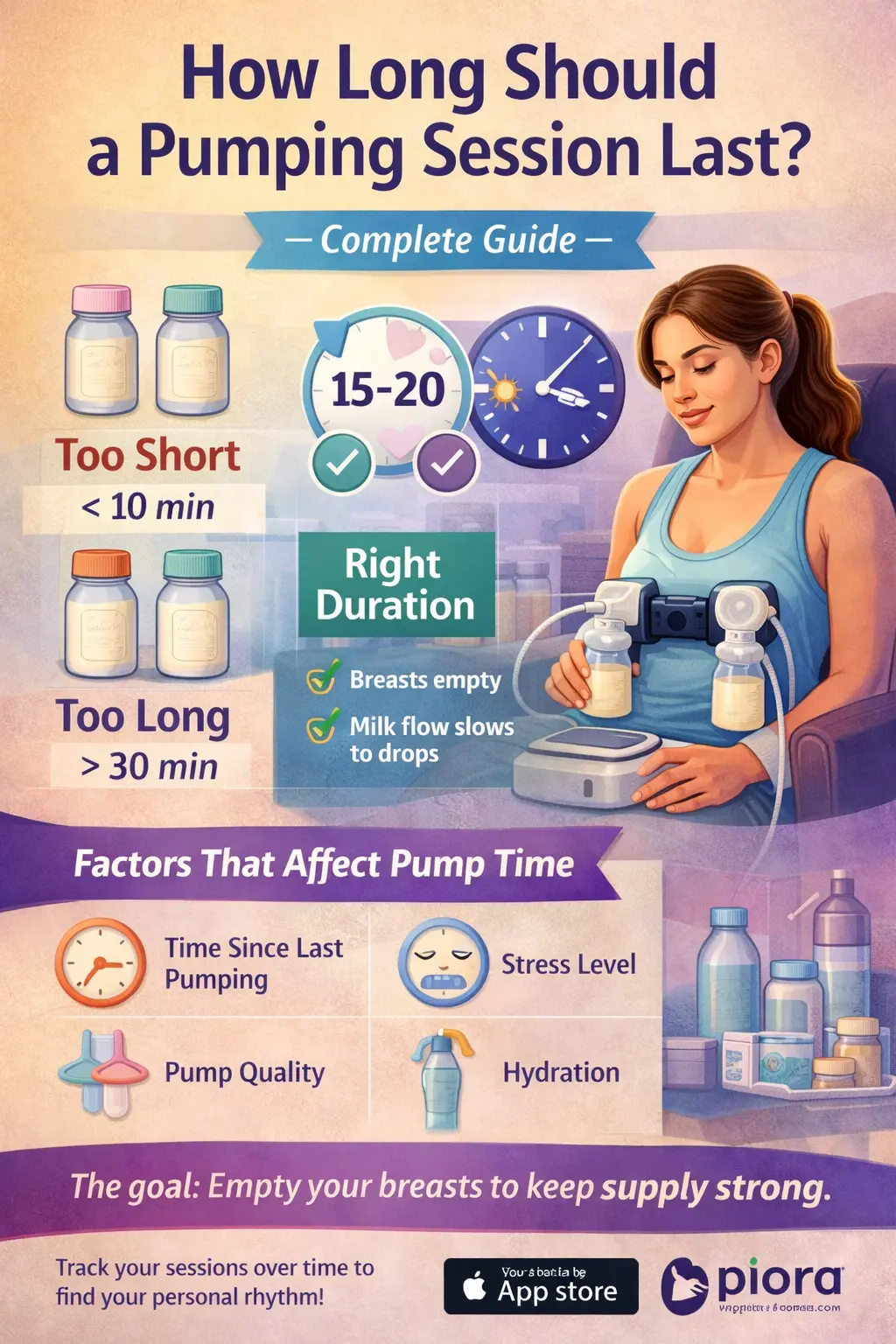
How Long Should a Pumping Session Last? (Quick Answer)
According to La Leche League International, most pumping sessions should last 15–20 minutes per side, or until milk flow slows to drops for 2–3 minutes. For double pumping, 15–20 minutes total is usually sufficient.
The goal is to fully empty your breasts — not to pump for a set amount of time.
| Situation | Recommended Duration |
|---|---|
| Double pumping (both sides) | 15–20 minutes |
| Single pumping (one side) | 15–20 minutes per side |
| Power pumping session | 60 minutes total (with breaks) |
| Quick session (missed pump) | 10 minutes minimum |
Why "Empty the Breast" Matters More Than the Clock
Your body produces milk based on demand. The more completely you empty your breasts, the stronger the signal to produce more milk.
Stopping too early — even by a few minutes — means leaving hindmilk behind. Hindmilk is higher in fat and calories, and it's also the signal that tells your body the breast is empty and needs to refill.
- Milk flow typically slows after the first let-down (around 5–8 minutes)
- A second let-down often occurs around 10–12 minutes — don't stop before this
- When flow reduces to drops for 2–3 consecutive minutes, the session is complete
What Affects How Long Your Session Takes
Not every session takes the same amount of time. Several factors influence duration:
- Time since last session — longer gaps mean more milk and potentially longer sessions
- Stress levels — stress delays let-down, making sessions feel longer
- Pump quality and fit — a poorly fitting flange reduces efficiency significantly
- Time of day — morning sessions often yield more milk and may take slightly longer
- Hydration and nutrition — dehydration slows milk flow
If stress is consistently making your sessions longer: How stress affects milk supply and let-down →
Signs You're Pumping Too Short or Too Long
Use this table to self-diagnose your sessions:
| Sign | Too Short | Too Long |
|---|---|---|
| Breast feel after | Still full or heavy | Empty but sore |
| Output | Lower than expected | No increase after 20 min |
| Supply trend | Gradually decreasing | Stable but nipples hurt |
| Between sessions | Engorgement or discomfort | Nipple irritation |
| Session duration | Consistently under 10 min | Consistently over 30 min |
How to Shorten Sessions Without Losing Output
If you want to pump more efficiently without sacrificing output:
- Massage before pumping — stimulates let-down faster
- Use breast compressions — keeps milk flowing between let-downs
- Warm compress — helps milk flow more easily
- Relax — stress is the #1 cause of slow let-down
For more techniques to improve efficiency: Advanced pumping strategies to maximize output →
Tracking Session Duration Over Time
Most moms don't realize how much their session duration varies day to day — and what those variations tell them.
- Sessions that take longer than usual often signal stress or dehydration
- Consistently short sessions with good output mean your body is responding well
- Tracking duration alongside output helps you spot patterns and optimize your routine
Piaora lets you log both duration and output for every session, so you can see exactly what's working. Try our free Pumping Tracker →
Final Thoughts
There's no single right answer to how long a pumping session should last — because every mom and every session is different. The goal is always the same: fully empty your breasts, then stop.
Pay attention to your body, track your sessions, and adjust based on what you observe. Over time, you'll develop a feel for when you're done — and your routine will become faster and more efficient.
Log your session duration and output to find your personal pumping rhythm.
Learn more about Pumping Tracker →Related Articles
Written by
Piaora Editorial Team
Evidence-based guides on pumping, breastfeeding, and PCOS — researched with input from lactation professionals and written for real moms.
Learn more about our team and editorial standards →